
Following today’s Solana news, the network cut its target slot time from 300 milliseconds to 250 milliseconds on Friday, according to Solana blockchain data, pushing the network’s block cadence up by nearly 17%. That takes Solana from roughly 3.3 slots produced each second to a target of four, giving wallets, exchanges, and trading applications a fresher, more current view of the network.
Here is the tension worth sitting with: Solana’s clock is now ticking noticeably faster, and validators are handing off control sooner than before, but the network’s sustained transaction capacity has not moved. The reason is mechanical, not marketing. It’s worth understanding before anyone assumes faster blocks mean a bigger highway.
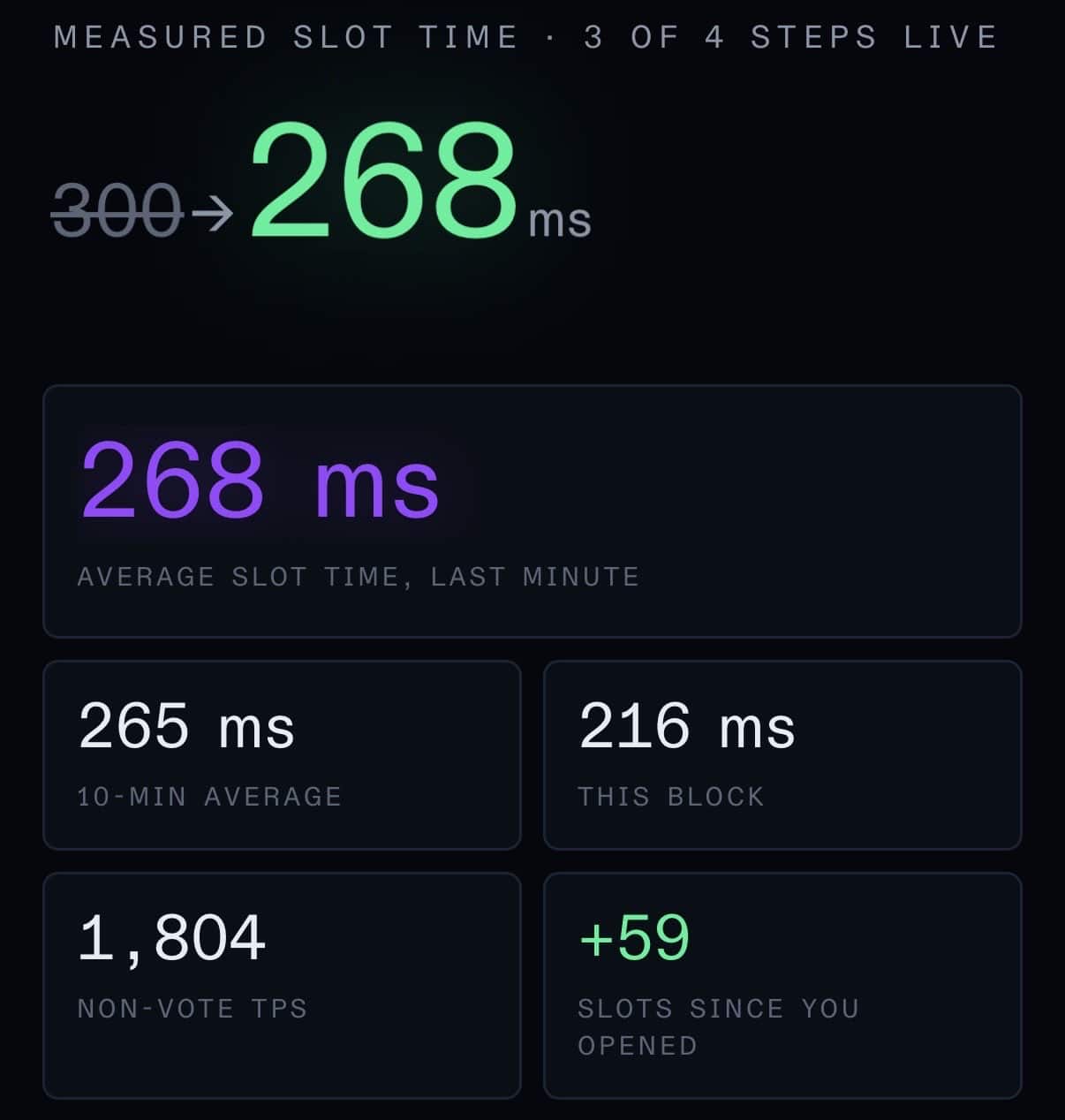
BREAKING: @Solana slot time has dropped to 250ms for the first time after the latest reduction under SIMD-0525 went live at epoch 1037.
The network has now reduced its target slot time from 400ms to 250ms, with 200ms as the final target. pic.twitter.com/ANqvgY7kf9
— SolanaFloor (@SolanaFloor) September 18, 2026
Discover 800+ Trading Pairs You Can Trust With Kraken
What Happens When Solana’s Slots Get 50 Milliseconds Shorter?
A slot is the brief window during which a single designated validator can add a block to the chain. Under Solana’s leader-rotation design, validators still hold that leader role for four consecutive slots. Because each slot is now shorter, a validator’s total control window shrinks from 1.2 seconds down to one second.

That shorter window matters most for latency-sensitive corners of DeFi. Oracle-fed markets and automated market makers, where a lagging price feed or a few hundred milliseconds of uncertainty can be the difference between a trade executing as intended and a user eating unexpected slippage. Shorter blockchain latency between submission and inclusion means swaps have a narrower window for the market to move against a user before the transaction actually lands.
The mechanics resemble a train station tightening its schedule: cutting the wait between trains from 30 seconds to 25 seconds eases platform congestion and gets passengers moving faster, but each train still carries the same number of people. Solana’s blocks are that train: arriving more often, not carrying more.
For readers wanting a deeper look at how throughput and scaling interact on Solana, this breakdown of Solana’s transaction and scaling roadmap covers the broader context.
Does More Slots Per Second Mean More Capacity?
The proportional trade-off is written directly into the upgrade proposal, known as SIMD-0525 (Solana Improvement Document 525). It mandates that the computation and data permitted within each slot decrease by the same ratio as the slot’s duration. More slots arrive per second, but each one is allowed to carry less work, so the network’s wall-clock processing ceiling stays roughly where it was.
That leaves real operational costs on the table. Node infrastructure now has to ingest and store a higher volume of smaller individual blocks, and any application that estimates elapsed time by multiplying a slot number against a hard-coded duration constant will start drifting from reality. Blockhashes, the short-lived references transactions use to prove they were signed recently, also expire sooner in real time, which squeezes flows that rely on offline signing or delayed human approval.
This is the third stage of a rollout that has walked Solana’s slot time down from 400 milliseconds to 350, then 300, and now 250. Because an epoch is fixed at 432,000 slots regardless of slot duration, the expected epoch length has compressed from roughly 36 hours to about 30. A further cut to 200 milliseconds would push the network to five slots per second and epochs near 24 hours, but developers have set no mainnet date for that step and say it will proceed only if block-skip rates.
The frequency with which validators miss their turn to produce a block stays within acceptable bounds following this 250-millisecond stage.
Solana News: Faster Clock, Same Ceiling

The evidence supports a genuine latency win: block cadence is up nearly 17%, validator leader windows are tighter, and applications get more current data to work with. What it does not support is a capacity claim: nothing in the record points to a 17% jump in transaction throughput or a higher maximum TPS ceiling. Anyone following Solana news for the next throughput breakthrough should read this one carefully: the network just got faster at updating itself, not bigger at processing.
The variable to watch is block-skip rates as the network runs at 250 milliseconds in production; that data will determine whether Solana ever moves to the final 200-millisecond stage. Until then, the fair read is that Solana just got faster at updating itself, not bigger at processing.
EXPLORE: Best Crypto Presales With Asymmetric Upside in the Current Market
Follow 99Bitcoins on X For the Latest Market Updates and Subscribe on YouTube For Daily Expert Market Analysis.
The post Solana’s 250ms Clock Shrinks Validator Control Windows appeared first on 99Bitcoins.