

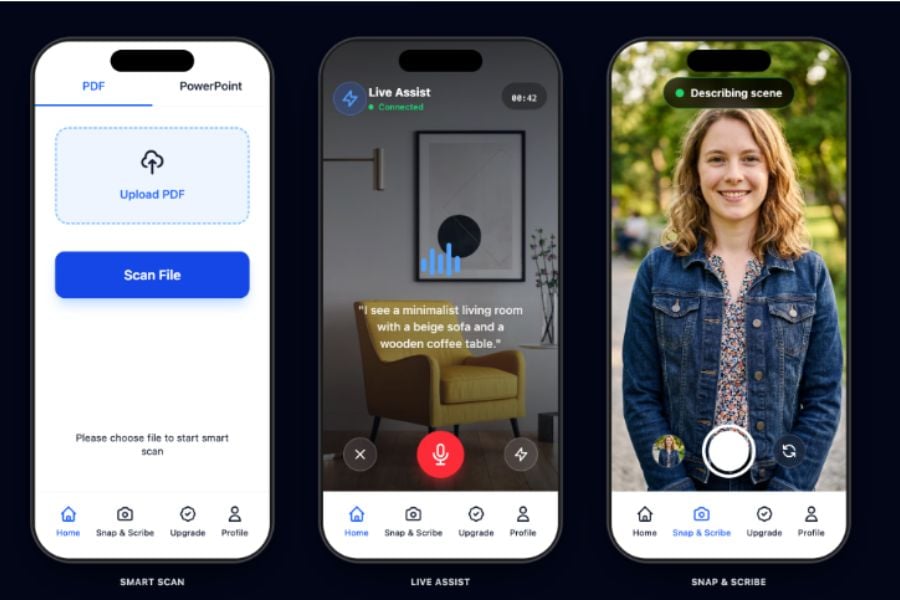
For blind users, AI is becoming more than a chatbot; it can be a window into the world around them.
That is the idea behind ScribeMe, an app created by 20-year-old Egyptian entrepreneur Mark Morad after he struggled with tools that could read text but could not adequately explain charts, diagrams, and other visual material in his schoolwork.
ScribeMe uses AI and computer vision to turn camera footage into spoken descriptions through a smartphone or Meta smart glasses, allowing blind and low-vision users to identify objects, understand their surroundings, and ask questions about what is in front of them.
ScribeMe started with a problem in the classroom
ScribeMe grew out of a problem Mark Morad and his sister encountered after losing their sight: the accessibility tools available to visually challenged people could read text quite well, but they could not always explain the visual information around it.
That became especially difficult in school, where charts, diagrams, and equations were often just as important as the written material. According to Reuters, the need to find a solution prompted him to write to developers, but he received no response.
Morad then taught himself how to code using YouTube tutorials. He developed a working version of ScribeMe by 2023, solving his immediate problem with schoolwork.
ScribeMe scores another utility win for AI
What started as a way for Mark to understand his schoolwork has since grown into an app that can help users interpret the world around them.
ScribeMe uses a smartphone camera to capture visual information, then AI processes what the camera sees and turns it into spoken descriptions. Users can ask questions about their surroundings, identify objects, and learn what is happening in front of them, giving visually challenged users a way to access visual information without relying on another person.
Reuters cited a June 2026 trip to Kenya as an example of how that works in practice.
Mark’s sister Karen used ScribeMe through Meta’s smart glasses during a safari, with the system describing the animals around her, including what they were doing and how far away they were.
The Meta glasses integration pushes that utility further. Instead of holding a smartphone up to whatever they want the AI to examine, users can use the glasses’ camera to capture their surroundings hands-free.
For Meta’s smart glasses, which have recently faced privacy scrutiny, ScribeMe illustrates another side of camera-equipped wearables: the same hardware that raises concerns about recording and surveillance can also support accessibility applications.
In this case, AI interprets that visual information and converts it into audio, giving blind users access to parts of the physical world they cannot see, just as live translation helps users break language barriers with ease.
More must-read AI coverage
Availability and pricing
ScribeMe is available for free download on iPhone and Android and, per Reuters, currently has thousands of users in 140 countries.
The free version gives users access to the app, while more advanced features sit behind a subscription. Reuters reports that ScribeMe charges $20 per month or $200 per year, putting the annual plan at roughly $16.67 per month when paid upfront.
ScribeMe is a relatively small example of a broader shift in accessibility technology: multimodal AI can increasingly interpret information that traditional screen readers were never designed to handle. For blind and low-vision users, that could make AI most useful not as a chatbot, but as an interface to the physical world.
Other News: Apple may be preparing camera-equipped AirPods that use Visual Intelligence to give Siri greater awareness of a wearer’s surroundings, according to a demo discovered in a leaked macOS update.