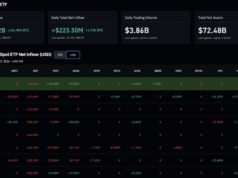

As I write this, Bitcoin is coming off of conceivably its worst week ever.
It started out with the January 31, 2026 release of batch number two of the Epstein files, which implicated none-too-few Bitcoiners and early stage Bitcoin companies (I wonder, will we still be talking about Epstein in 2036?).
The release now reads like a nasty omen. Because on Thursday of the same week, bitcoin suffered its fourth worst drawdown ever, a 21% bludgeoning that bled $16,000 from its price as it went from $76,000 to $60,000 in a single day.
This was gnarly for bitcoin holders, of course, but it was gnarlier still for Bitcoin miners, who were already suffering under historically low revenue compression.
Bitcoin hashprice – a measure of mining revenue in either USD or BTC per unit of hashrate – hit an all-time low of $28.90/PH/day, according to Bitcoin mining data platform Hashrate Index. This means that 1 petahash of hashrate (roughly five new generation ASIC miners) would net you a paltry 28 dollars and 90 cents.
A bum can make a better daily wage panhandling.
It’s no surprise, then, that Bitcoin’s difficulty experienced 6 negative difficulty adjustments (out of 7 total) in three months between November 12, 2025 and February 7, 2026 (and the only positive adjustment was 0.04% on Christmas Eve). The last time we had a string of adjustments like that? 2011.
2011, y’all – when early tinkerers were mining with the computing power equivalent of a toaster compared to modern ASIC miners.
Now, bitcoin’s anemic price isn’t the only factor weighing on difficulty. Bitcoin miners are also pivoting to AI, and they are starting to decommission their ASIC fleets to make room for The Next Big Thing™.
But the economic stress miners are facing right now offers a decent glimpse into the future of an industry whose underlying commodity trades in backwardation on a long enough timeframe. Put another way, hashprice is trending to zero, so what does that mean for Bitcoin?
Nothing good. But also, nothing bad, either.
For sale, blockspace. Used once.
Before we prognosticate, let’s examine where the Bitcoin mining industry is now.
I said earlier that hashprice is trending to zero. This is due to a combination of Moore’s law – as semiconductors improve, so too does the energy efficiency of ASIC miners, meaning miners can produce more hashrate with fewer electrons, which puts pressure on Bitcoin’s difficulty and reduces the rate of mining rewards per unit of hashrate – and the Halving.
The block subsidy will eventually hit zero. By 2036, it will be 0.78125, so for the block subsidy to offer the same nominal payout under today’s 3.125 BTC subsidy given current BTC prices (roughly $212,000), bitcoin will need to be $272,000.
Failing that, Bitcoin miners better pray for fat transaction fees. But even here, the trend is working against them. Right now, you can get a transaction confirmed for under 1 satoshi per virtual byte (sat/vbyte).
Bitcoin adoption is at an all-time high but the mempool is a ghosttown. Part of this is thanks to data-efficient upgrades like SegWit and Taproot, but it’s also because Bitcoin is scaling as Hal Finney predicted: via Bitcoin banks, be those exchanges, other custodians, or paper products like the ETFs.
The only truly meaningful on-chain use of the last three years has come from what some Bitcoiners call shitcoins: ordinals and inscriptions, which ironically were largely adopted by “shitcoiners” from the realms of Ethereum and Solana.
Please set aside any moralizing, kvetching, and pearl clutching for a moment. It doesn’t matter if you love or hate monkey JPEGs on Bitcoin, but you need to acknowledge that they were a boon for miners and they buoyed block rewards before and after the 2024 Halving.
This market is dead now, though, and so far no Layer 2 or alternative use case for the blockspace has filled the vacuum they left. Given the lack of adoption for the swathes of Layer 2 projects that were paraded out during the ordinals mania to great fanfare, I think it would be wise to not count on such platforms generating meaningful fees in 10 years. Hopefully they will! But I wouldn’t bet on it.
Maybe in the age of AI people will start using Bitcoin timestamps for content and identity attestation – or some other, unforeseen use of blockspace will pop up – but again, I’m not holding my breath.
It is likely, however, that AI produces at least some positive externalities for Bitcoin miners, even if it also brings with it negative ones.
The coming domin(AI)tion blackpill
The biggest trend in Bitcoin mining over the last year has nothing to do with Bitcoin.
The largest Bitcoin miners in the world – Core Scientific, Riot, IREN, Cipher, CleanSpark, Hut 8, TeraWulf, among others – have started swapping ASICs for GPUs to cash in on the LLM gravytrain.
It’s almost a retrograde movement, except the GPUs aren’t producing nonces for miners as they once did – they’re running AI or high-performance computing loads.
I’m not sure how many Bitcoiners have played this tape through, or pondered the implications of it. Publicly traded Bitcoin miners – the ones making these pivots, or at least the ones making the most noise about them – account for roughly 40% of Bitcoin’s hashrate. And they’re trying to find a way to convert every basis point of this total into computing fodder for Claude, ChatGPT, Gemini, etc.
If you’re wondering why, it’s simple dollars and cents. They can monetize their megawatts for much greater sums than mining bitcoin. Sorry if that shatters any illusions you may have about the fabled altruistic miner who is hashing to defend the network against those dastardly bad actors.
This is a good thing actually. Firstly, it’s a headwind for hashrate growth, which is a tailwind for mining profitability. Fewer mega miners means more satoshis to go around for everyone else, but perhaps more importantly, it takes a cohort of Bitcoin miners out of the game who have lopsided operational and financing advantages.
Specifically, I’m talking about public miners’ access to capital markets, which allows them to aggressively scale their hashrate even if they are not profitable. Not making enough from mining to cover your costs? No problem – just dilute your shareholders! For years, public Bitcoin miners have issued new equity, sold it into the open market, and used the proceeds to shore up operation costs and expand their operations more quickly than private miners.
The end result is that Bitcoin’s hashrate has grown much more quickly than we might otherwise expect. When China dominated mining, Bitmain fueled meteoric hashrate growth with its self-mining and via the proxies in its spoils system. Since the China Mining Ban in 2021 shifted hashrate to the U.S., the rapid proliferation of public miners has had the same effect.
But the promise of an AI payday will be too tempting for these companies to ignore, so this new computing application will take these public miners out of the game. And this shift will be as dramatic as The Great Hashrate Migration after China’s 2021 Bitcoin mining ban.
The megaminer disintermediation whitepill
This coming change isn’t a blackpill, though. It’s a whitepill.
As mega-miners fade into the background, the smaller and medium-sized miners, those who operate on the margins, on the outskirts, and who have little chance of converting their operations into another form of data center, will thrive – or at least survive.
Ten years from now, the majority of hashrate should come from these Bitcoin miners, not the publicly traded companies who could mine without regard for actual profitability. Those miners who are around in 2036 will be scrappy, shrewd, and nimble. They will have some edge that makes their operations economical, be that recycling heat; mining off-grid on oil and gas wells, wind farms, or solar arrays; or be integrated on the power-plant level.
For the few large scale miners that will still exist at this time, they will likely be among the last bunch in that list: Bitcoin mining operations that run on energy-producing assets, from nuclear sites to natural gas plants, to soak up excess electricity whenever there is a bumper crop of production.
Perhaps it goes without saying, but of course, this assumes that block rewards are healthy enough to sustain hashrate even on the margins. To return to our math in the second section, bitcoin will need to be at least $272,000 to match the value of the current block subsidy.
Ideally, transaction fees make up more than ~1% of the block subsidy, which has been the theme for more than a year, but there’s no guarantee that this will be the case. (Even if they don’t, though, miners with the lowest cost energy will still be mining assuming bitcoin isn’t totally worthless.)
Energy efficiency gains from ASICs will help pick up the slack for overall profitability, but only so much, as the watt-per-terahash ratio is improving at a slower and slower rate and will virtually plateau at some point in the future given the current trajectory.
The last five years have been the exception, not the rule
But again, all of this is a good thing, actually, because it will disintermediate the largest actors in the Bitcoin mining industry, which consequently serve as potential chokepoints that could compromise the network.
The public miners are an obvious centralization point here. These are highly scrutinized, legally compliant firms that will bend the knee to Uncle Sam if it threatens their business. (Lest we forget, MARA (formerly, Marathon Digital Holdings) started mining OFAC-compliant blocks – blocks that censored any transaction connected to an OFAC-sanctioned Bitcoin wallet – in 2021, despite the fact that there was no law or legal precedent to mandate such an action).
Less obvious, though, is the threat that Bitcoin mining pools present to Bitcoin’s permissionless and censorship-resistant ethos. The vast majority of mining pools operate using a full-pay-per-share (FPPS) payout method. This means that miners are paid regardless of how many blocks the pool mines, using the hashprice metric we covered in the introduction. This model, the obverse of the pay-per-last-n-share (PPLNS) that Slushpool (now Braiins Pool) pioneered in 2011, means that the pool assumes all of the risk of mining, and they act as insurance companies of sorts for miners by guaranteeing income regardless of how much bitcoin the pool is actually mining. For example, if an FPPS pool mines 10 blocks a day and is responsible for 9 blocks worth of payouts, they pocket the difference, but if they mine 8 blocks, they eat the difference.
As hashprice becomes increasingly compressed with each successive block subsidy halving, it will become increasingly difficult for FPPS providers to cover the risk of mining luck while guaranteeing payouts. This becomes even more difficult if transaction fees start making up even a modest amount of total mining revenue, because FPPS pools typically calculate hashprice using the base block subsidy plus a rolling average of transaction fees over a given period. Put another way, what happens when an FPPS pool has to pay its miners using a hashprice that assumes transactions make up 10% of mining revenues, but the blocks this pool mines only make half of that?
Pool solvency becomes a mounting concern, and so FPPS pools will have to either adapt, or another model – either old or new – will take its place out of necessity.
This is another positive still, because it neutralizes another weak point for Bitcoin. Right now, Foundry, a U.S.-based mining pool, mines 1/3rd of Bitcoin blocks. What do you think would happen if the U.S. government tells Foundry to censor certain transactions, and create a white and black list for approved or sanctioned Bitcoin wallets?
If FPPS fades into the background, we might expect self-mining and PPLNS-esque payouts to dominate, and this should eat into the market share of large FPPS pools and mitigate the above risk. (The counterfactual to this hypothetical, just to be intellectually honest, is that as Bitcoin mining becomes more variable, one or two pools end up dominating marketshare, as only the largest companies have enough sway to attract users and make good on their payout promises).
Ultimately, Bitcoin mining just isn’t a good business, and that’s actually a good thing. A dwindling block subsidy and hashprice will push mining to the margin, to the lowest cost of energy possible, with operators that can only scale with prudence and diligence. In ten years, Bitcoin mining will likely be much more distributed than it is now as a result.
It’s entirely possible, then, that we look back on the mega-mining meta that became popular in the U.S. after the China Mining Ban as an aberration rather than the norm – another product of a fiat-warped, zero-percent interest rate policy economy that was doomed to expire when the accounting stopped making sense.

Don’t miss your chance to own The 2036 Issue — featuring articles written by many influential figures in the space pondering the challenges of the next decade!
This piece is featured in the latest Print edition of Bitcoin Magazine, The 2036 Issue. We’re sharing it here as an early look at the ideas explored throughout the full issue.