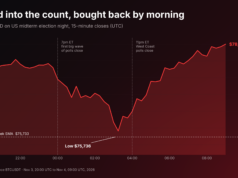


Bitcoin price traded near $78,300 on Wednesday morning, up about 1% on the day, after Democrats won control of both the House and the Senate in Tuesday’s midterm elections and dealt the crypto industry its worst night in Washington since 2022.
The Associated Press called the Senate for Democrats late Tuesday and the House early Wednesday. House Minority Leader Hakeem Jeffries is in line to become speaker. The result exceeded most forecasts: by Wednesday morning the AP tracker showed Democrats with 54 Senate seats to Republicans’ 44, with races still open.
Prediction markets had put a Democratic House above 90% for weeks, but the Senate margin and the loss of several Republican crypto allies in the House came as a surprise.
The bitcoin price reacted in two moves. Bitcoin fell to $75,618, a seven-week low, as results came in during Asian trading, then recovered the full loss and more by the European open.
Traders broadly speaking treated the sweep as the removal of a known risk rather than a shock: prediction markets had priced a Democratic win for weeks, and options desks saw heavy call buying on election day, with block volume more than double the prior session.
The view on the desks is that a Democratic Congress is less friendly to crypto legislation but that divided government, a presidential veto and executive orders cap how much policy can change, leaving technical targets near $82,000 as the next test.
Demand remains the weak point, with U.S. spot bitcoin ETFs shedding about $1.16 billion over three sessions and the price still about 27% below where it stood a year ago, down from about $80,500 a week before the vote.
The races that cost bitcoin and crypto
The industry’s super PACs spent more than $170 million this cycle, most of it for Republicans, and the headline bets failed. Sherrod Brown won back an Ohio Senate seat in a special election against Sen. Jon Husted despite about $64 million in crypto money aimed at stopping him, the largest sum the industry has spent against any single candidate.
Brown chaired the Senate Banking Committee until his 2024 defeat and spent that tenure resisting market structure bills. Senate seniority rules may limit his path back to a gavel, but he returns to a chamber his party controls.
Three House Republicans the industry counted on lost their seats: Bryan Steil of Wisconsin, who fell to ER nurse Mitchell Berman; Zach Nunn of Iowa; and Ann Wagner of Missouri. Stand With Crypto had endorsed Steil and Nunn and directed ad money to both. Mike Lawler of New York conceded to Democrat Cait Conley with the race uncalled. House Financial Services Chairman French Hill appears to have held his Arkansas seat but will hand the gavel to Rep. Maxine Waters.
Pro-bitcoin Talarico wins in Texas
The night produced one result bitcoin advocates will claim. Democrat James Talarico defeated Ken Paxton in Texas, the first Democratic statewide win there since 1994 and the first Senate win since 1988, with about 55% of the vote.
As a state representative, Talarico voted for SB 21, the bill that created the Texas Strategic Bitcoin Reserve, on both House passages in 2025. In Kentucky, Rep. Andy Barr, an industry ally, won Mitch McConnell’s open Senate seat, and Sen. Pete Ricketts of Nebraska held his.
Strategy Chairman Michael Saylor said Wednesday that “the case for holding Bitcoin crosses party lines,” pointing to Florida’s election of Republican Byron Donalds, who as a congressman sponsored legislation to codify the U.S. Strategic Bitcoin Reserve, and Texas’s election of Democrat James Talarico, who as a state representative voted for the 2025 bill that created the Texas Strategic Bitcoin Reserve.
What a Democratic Congress means
In theory, the CLARITY Act is the first casualty. The market structure bill passed the House 294-134 in July 2025 and failed a Senate cloture vote 49-50 on Sept. 15. It dies if Congress does not pass it before the new session convenes on Jan. 3, and TD Cowen’s Jaret Seiberg wrote Tuesday that a Democratic sweep means no market structure law for two years.
Sen. Angela Alsobrooks, a CLARITY negotiator, has said a lame-duck vote remains possible, which makes the next eight weeks the industry’s last window on the current text.
Committee control changes next. Sen. Elizabeth Warren is in line to chair Senate Banking, where she has opposed the bill; Waters returns to House Financial Services. Incoming House
Oversight Chairman Robert Garcia posted two words at 3:18 a.m.: “LAWYER UP.” Democrats have said they will examine the Trump family’s crypto ventures, the pardon of Binance founder Changpeng Zhao and the agencies’ handling of the industry, a list that grew after last week’s $6.34 billion Binance hack.
Senate control also gives Democrats a hand in staffing the SEC and CFTC, where Trump must now fill the minority seats to move nominees. That matters because the agencies have carried crypto policy without Congress, from the CFTC’s approval of bitcoin perpetuals in May to Tuesday’s equity perps decision. The GENIUS Act, signed in 2025, takes effect Jan. 18 regardless of the result.