

Bitcoin closed the second quarter of 2026 mired in its deepest and longest downturn since the last bear market, according to Bitwise Asset Management’s newly released Q3 2026 Crypto Market Review.
Yet the $9 billion crypto asset manager frames the pain as a setup rather than a collapse, arguing the industry has never been sturdier beneath the surface.
Bitcoin fell 13.4% in Q2 and is down 32.9% for the year, dropping below $60,000 in June for the first time since 2024 and landing roughly 52% under its October peak of $126,080. That extends what Bitwise calls “crypto winter” to nine months and marks the third straight quarter of negative returns for the broader Bitwise 10 Large Cap Crypto Index, its longest losing streak since 2022.
Chief Investment Officer Matt Hougan does not sugarcoat it, writing that “the vibes in crypto are among the worst I’ve seen in my eight years in this industry.”
Even so, bitcoin held up far better than most of its peers. Its 32.9% year-to-date decline was the shallowest drawdown among major large-cap tokens, easily beating Ethereum’s 46.9% slide, Solana’s 40.6% and Cardano’s 56.5%.
Bitcoin now commands a 64.2% share of the roughly $1.88 trillion total crypto market and carries a 77.4% weight inside the Bitwise 10 index, cementing its status as the sector’s relative safe haven even in a broad selloff.
Bitcoin ETF outflows hit a record
The quarter’s most jarring statistic came from the exchange-traded product complex that has anchored bitcoin’s institutional era. U.S. spot bitcoin ETPs bled $4.9 billion in Q2, their worst quarter since launching in January 2024, according to Bitwise.
Assets under management still stand at $72.4 billion, with $53.4 billion in cumulative net flows since inception, but the reversal underscored how quickly professional sentiment can sour.
Filings show investment advisors hold about 43% of professionally owned ETP shares and hedge fund managers another 28%, with Jane Street ($1.8 billion) and Millennium ($1.0 billion) the largest reported holders.
Structural demand nonetheless continued to outstrip new issuance. Bitwise noted in their report that spot ETPs and public companies have together bought roughly 3.6 times the bitcoin mined since the ETFs debuted — about 1.55 million BTC of demand against just 455,416 BTC of new supply.
Treasury companies keep buying, but Strategy blinks
Public-company bitcoin treasuries grew to 1.28 million BTC, up 11.3% quarter over quarter and equal to 6.11% of the 21 million cap, even as the number of firms holding bitcoin slipped by three to 184. Companies added 130,467 BTC in Q2. Strategy remains the runaway leader at 846,842 BTC, trailed by XXI (43,514), Metaplanet (40,177), MARA Holdings (35,303) and Bitcoin Standard Treasury Company (30,021).
The most symbolically loaded move belonged to Strategy, which sold bitcoin for the first time since 2022 — offloading $218 million late in the quarter to fund dividend obligations while keeping holdings valued at $52.3 billion and a $2.55 billion cash reserve. Falling prices punished the equity harshly: Strategy’s stock (MSTR) dropped 30.3% in Q2 and 42.8% year to date, making it one of the worst performers among crypto equities.
The report also touched on several developments that are reshaping bitcoin’s market plumbing. The CFTC approved the first bitcoin perpetual futures at a U.S.-regulated exchange, Kalshi, pulling crypto’s dominant derivative onshore.
Charles Schwab launched retail spot BTC trading, and E*Trade extended access to its 8.6 million users. On the regulatory front, the market-structure CLARITY Act stalled in the Senate over ethics provisions, with prediction markets pricing its 2026 passage odds at just around 20%, down from 75% in May.
Bitwise argues that if CLARITY passes it would likely mark the bottom, and if it fails the industry keeps building under friendly regulators.
Hougan’s core argument is one of cycle-over-cycle progress. Bitcoin’s seasonality data offers modest near-term hope, with July historically averaging a 10.7% gain.
And the firm’s portfolio work still shows a 5% bitcoin allocation adding to a traditional 60/40 mix in 100% of three-year rolling windows since 2014.
“The market is quoting bear-market prices on an industry that is twice the size it was at the last cycle’s bottom,” Hougan writes — a foundation, he says, that “determines what grows in the spring.”
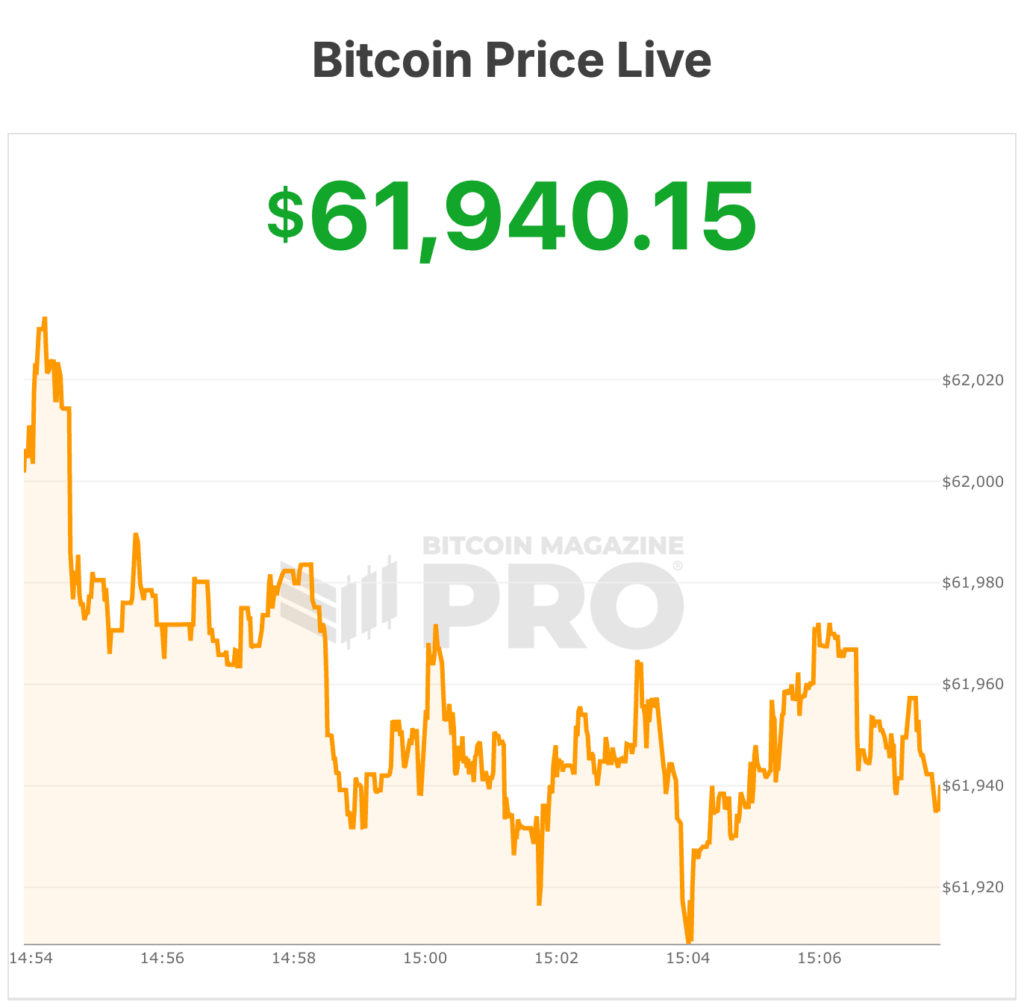
Bitcoin is trading below $62,000 today.