

China is rejecting calls from prominent U.S. AI leaders to slow frontier development, framing the proposal as another front in the technology rivalry between Washington and Beijing.
The trouble started over the weekend, when Anthropic CEO Dario Amodei published an essay urging AI companies to deliberately slow down development, warning that a “Chinese lead in AI would pose grave danger for the United States and the world.” OpenAI’s Sam Altman and Elon Musk both backed the idea.
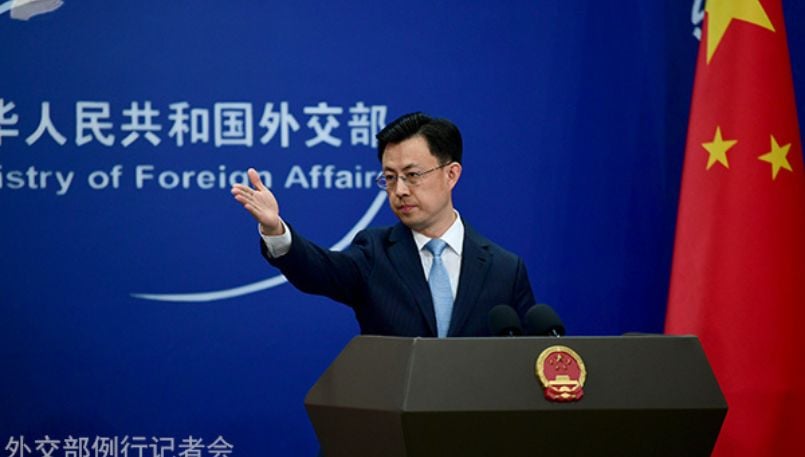
Beijing wasted no time firing back. Foreign Ministry spokesperson Guo Jiakun, per Bloomberg, told reporters Monday that “fearmongering, confrontation and vicious competition” will disrupt the process of “global AI governance” and will not be in anyone’s interest.
The state-run Global Times went further, branding the proposal a “Cold War script” for the AI sector.
Why it matters
This is more than a dispute between executives and diplomats. It exposes a basic problem facing U.S.-China AI coordination: both sides have incentives to talk about safety, but neither wants to accept limits that could leave the other with a strategic advantage.
With President Trump and Chinese leader Xi Jinping set to meet in Washington on Sept. 24, AI could become part of a broader negotiation over technology access, export controls, and economic competition.
What Amodei actually proposed
Amodei’s essay didn’t just call for caution — it named names. He described China as “the autocratic country with by far the most advanced AI capabilities” and pushed for restricting chip sales to Beijing while leaving room for eventual coordination.
President Trump struck a more competitive tone, telling reporters Sunday, “We’re leading China in AI. We’re the most sophisticated country in the world, and frankly I want to keep it that way because whoever wins AI wins.”
Meanwhile, China’s state security minister, Chen Yixin, offered his own framing, writing that AI “has become the main battleground in global technological competition and a new arena for strategic rivalry among major powers.”
The deeper problem
Strip away the diplomatic rhetoric, and both sides face the same strategic dilemma: slowing down unilaterally carries a cost if the other side keeps advancing. That’s a textbook standoff, and it’s why analysts doubt any real agreement is coming soon.
Ja Ian Chong, a political science professor at the National University of Singapore, told NBC News: “There’s the sort of talk of cooperation, but the behavior suggests otherwise, and underlying that behavior, I think, is this deep mutual suspicion.”
What makes this fight different from past U.S.-China tech disputes is timing. Chinese models are now landing within striking distance of American ones — Georgetown’s Helen Toner, per CNBC, estimated the gap at “something like six to nine months” — which means neither government has much appetite to blink first.
More must-read AI coverage
What it means going forward
For businesses and consumers, the practical fallout shows up in chip export rules. Companies building on U.S. or Chinese AI models should expect tighter restrictions on hardware and software access rather than any slowdown in raw capability; the race, if anything, looks set to accelerate.
Not every voice is pessimistic: Theo Bertram of the London-based Social Market Foundation suggested each country could pursue its own domestic safeguards even without a joint pact. But until Washington and Beijing agree on what “safe” even means, expect competition — not caution — to keep setting the pace.
More news: Microsoft has drafted a “Humanist AI” code that says future models must remain under human control, accept interruption and shutdown, and follow non-negotiable safety limits.


