

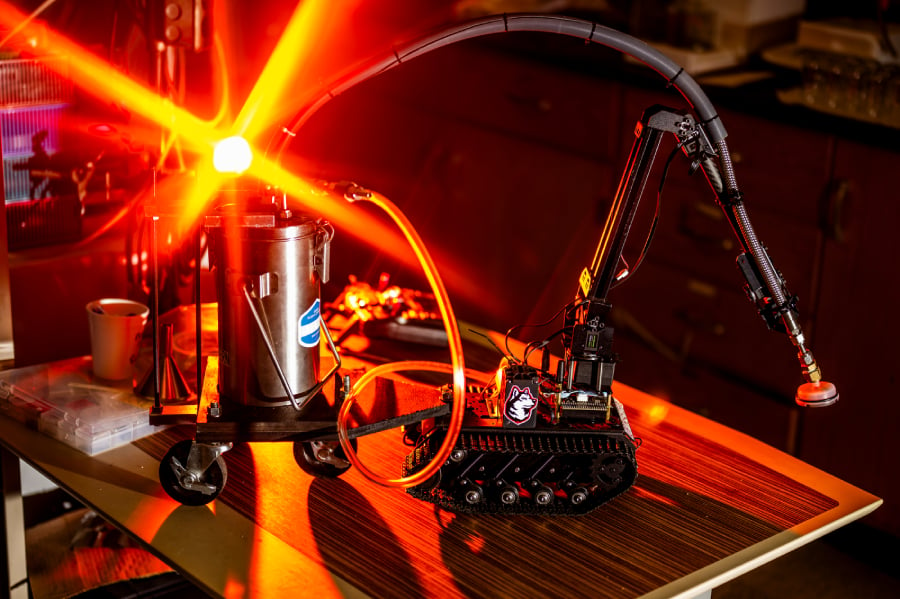
Yiannis Levendis, a professor of mechanical and industrial engineering at Northeastern University, has developed a prototype firefighting robot that sprays liquid nitrogen onto flames to extinguish them quickly. The project grew from a laboratory experiment in 2008, when Levendis was testing shredded tire rubber as a possible alternative fuel.
“Liquid nitrogen, when thrown on fire, quickly evaporates and expands into gas almost 1,000 percent,” Levendis said. “That suffocates the fire and creates a cooling effect on the fuel.”
He said the flames were extinguished almost immediately, prompting him to explore whether the same approach could be adapted for wildfire response. Northeastern Global News reported that the robot is designed to suppress small fires and hotspots before they grow into major wildfires.
How the robot works
The prototype, built with Northeastern students Hayden Hishmeh and Aobo Liu, resembles a compact all-terrain vehicle with caterpillar tracks, a liquid nitrogen tank and a spray hose. It can be operated remotely or potentially autonomously, allowing it to move into areas that may be too dangerous for firefighters.
Unlike many wildfire retardants, liquid nitrogen does not leave behind chemical residue. As it rapidly turns into gas, it cools burning vegetation while reducing the oxygen available for combustion. The robot is currently being tested on controlled fires using forest fuels common in wildfire-prone areas of the western United States.
Tom Ryden, executive director of MassRobotics, said the approach could appeal to firefighting agencies or industry partners.
“A perfect use for robots is to send them into dangerous spots,” Ryden said, according to Northeastern Global News. “Even if we lose a robot, it’s just the cost of the machine that’s lost, not a person.”
Levendis also believes the cryogenic system could eventually be adapted for much larger firefighting vehicles. “I believe it can be converted to vehicles as large as firetrucks,” he said. “We are fairly close.”
More must-read AI coverage
Field deployment still faces major hurdles
The technology is still in the prototype stage, and significant engineering challenges remain before liquid-nitrogen firefighting robots could be deployed in active wildfire operations. Cryogenic storage, transportation logistics and the amount of nitrogen required for sustained firefighting would all need to be addressed.
Even so, the project points toward a different strategy for wildfire response: using robots to attack small ignition points quickly, especially in terrain that is too risky for human crews. If that approach proves practical, it could become a useful complement to existing wildfire suppression methods rather than a replacement.
Also read: NASA’s robotic rescue mission shows how remotely operated machines can take on high-risk work where direct human access is limited.


