
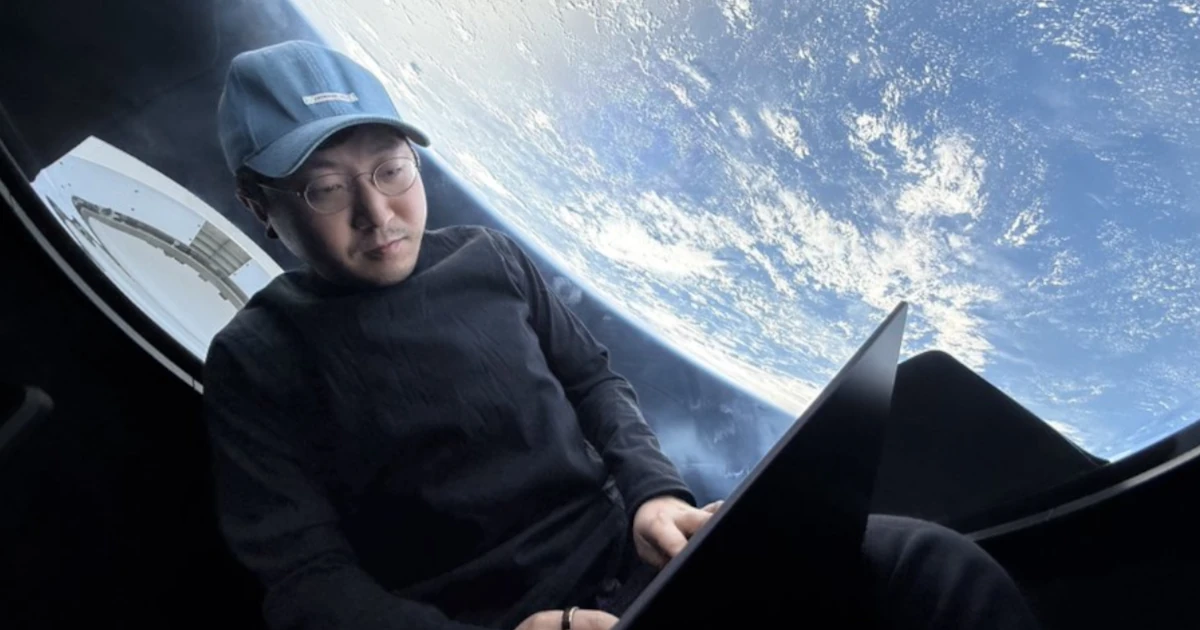
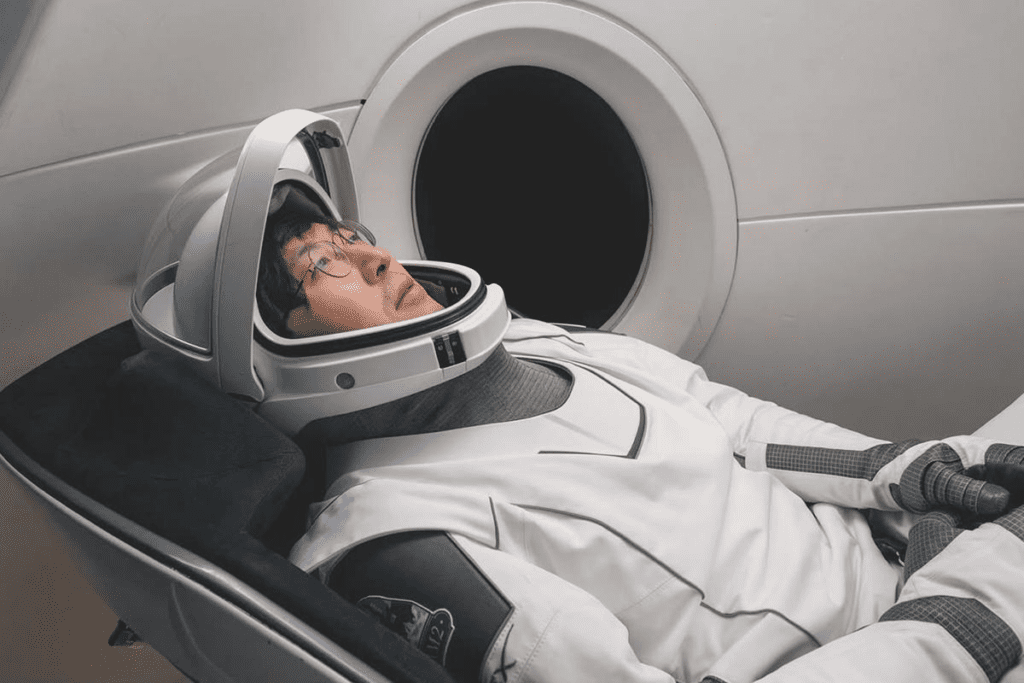
On March 31, 2025, Chun Wang, co-founder of the historic Bitcoin mining pool f2pool, launched as mission commander of Fram2—the first crewed spacecraft to enter a polar orbit. The SpaceX Crew Dragon Resilience lifted off from the Kennedy Space Center on a Falcon 9 rocket into a 90-degree retrograde inclination orbit passing directly over the North and South Poles. No prior crewed mission had achieved this trajectory; the previous highest inclination for humans in orbit was 65 degrees on the Soviet Vostok 6 flight in 1963.
In an exclusive interview with Bitcoin Magazine, Wang shared one of his most memorable moments in space: “I don’t remember much from my time in space, but gazing down at the Earth rotating below, I just kept thinking: we’re flying so fast, how could we possibly get back down to the ground? The distance itself isn’t actually that great, less than 500 km, but the enormous difference in velocity is what matters. It reminded me of what I learned about the uncertainty principle,” he added, referring to Heisenberg’s 1927 physics theorem, which states that there is an inherent limit to how precisely certain pairs of physical properties of a quantum particle can be known simultaneously. The most famous pair is position (x) and momentum (p, which is mass times velocity).
He continued, “Δx ⋅ Δp ≥ ℏ/2: position only makes sense when you consider momentum together with it. Both determine whether two objects can really ‘meet.’ Here, distance isn’t just the difference in position vectors; it must be considered together with the velocity vectors, too.” The two objects he was probably considering were Earth and the Fram2 spaceship he was aboard, both moving at incredible speeds, and which could easily miss each other for landing if not for the minds of great engineers.
Wang led an all-civilian crew of first-time astronauts: vehicle commander Jannicke Mikkelsen, a Norwegian filmmaker and polar explorer, pilot Rabea Rogge, a German robotics researcher, and mission specialist Eric Philips, an Australian polar explorer. The mission lasted three and a half days with no docking to the International Space Station. The primary objectives were polar Earth observation and execution of 22 research experiments.
Space may have been the most extreme travel destination for Wang, but it was far from the first. Wang is on a self-declared mission to visit every territory on earth, described on his X profile as “Documenting my travel to every country/territory in the world following ISO 3166: 60% (150 of 249) on 1 planet/moon(s) done and counting.” To date, he boasts over 1153 different flights around the world, averaging 36 a year, including many recent visits to Antarctica and polar regions.
Wang was not always such an avid traveler, however. Born in 1982 in Tianjin, China, Wang was five years old when his grandfather brought home a world map that sparked a lifelong obsession with exploration, but it wasn’t well into his adulthood that he began traveling the world, after building a legendary career as an early Bitcoin miner and pool operator. Computers entered his life early: he heard about them at age seven and owned his first 486 SX running MS-DOS by 13. He learned to code games and planetary gravity simulations. University followed through programming contests, but he dropped out without a degree and moved between software jobs across China.
Bitcoin entered his world in May 2011. Wang saw two articles on the Chinese tech site Solidot and spent the night reading the Bitcoin wiki. “Driven by curiosity, I opened the wiki link on en.bitcoin.it and studied it for one night. I finally understood everything, and it was like the discovery of the New World,” he wrote in his 2015 memoirs. He borrowed $40,000 from his father, mined on a MacBook at 800 khash/s, then scaled up with GPUs bought in Zhongguancun. Over the first two years, he personally mined 7,700 BTC, netting roughly 2,700 after power costs. He sold most in January 2013 at $11 to repay the loan.
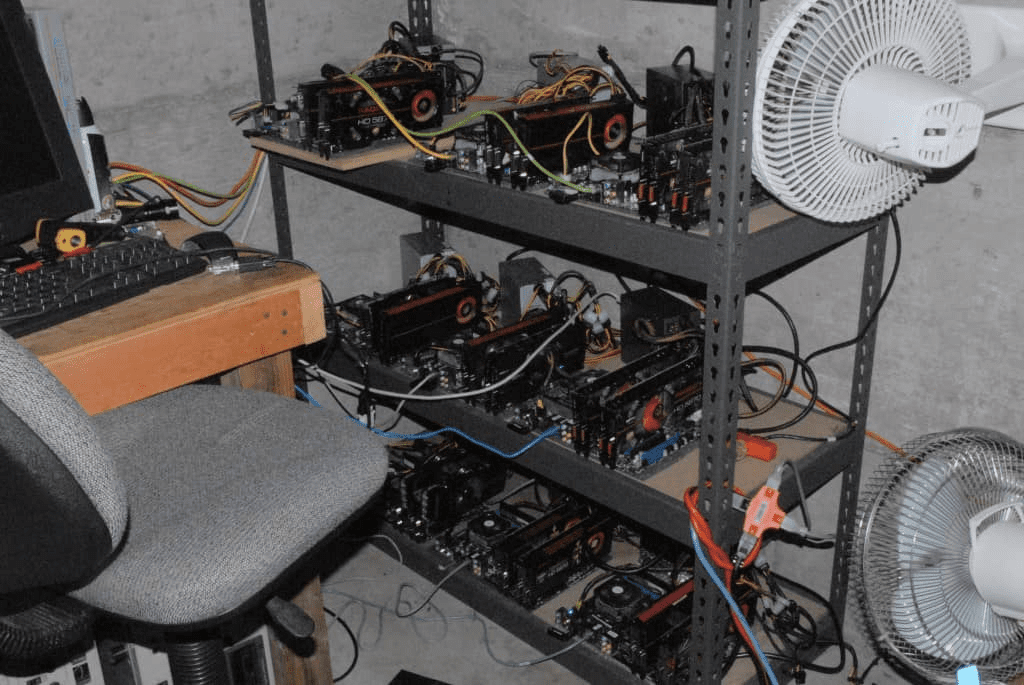
Early GPU mining rigs in China, the kind of setup Chun Wang used before founding f2pool. (Credit: f2pool official history)
In April 2013 Wang co-founded f2pool with Mao Shihang, known online as Discus Fish. They set up in Wenzhou. Wang coded the backend; Discus Fish handled operations. The pool launched on May 5 and quickly grew to command roughly one-third of Bitcoin’s hashrate at its peak.
To this day, f2pool mined over 1.3 million BTC, more than 9 percent of all blocks ever produced. It remains one of the largest and longest-running mining pools in Bitcoin’s history. During the 2017 block-size wars, the pool played a quiet but decisive role supporting Bitcoin’s Nakamoto consensus. Wang later stated: “Proof-of-work is the constitution of Bitcoin. Please respect mining and respect the miners. Without miners’ support, we wouldn’t have had SegWit activated, and we wouldn’t have made the Lightning Network possible.”
From 2014 through the early 2020s, Wang kept f2pool operating while navigating industry shifts, including China’s 2021 mining crackdown that pushed operations offshore. In 2017, he discussed the coming proof-of-stake era with Vitalik Buterin. That conversation led him to launch stake.fish in 2018, a non-custodial staking service that became one of the largest validators across Ethereum, Polkadot, Solana, and other networks. The move diversified his infrastructure business across the broader crypto industry, bringing his experience as a large operator to the rapidly transforming crypto market.
To The Moon
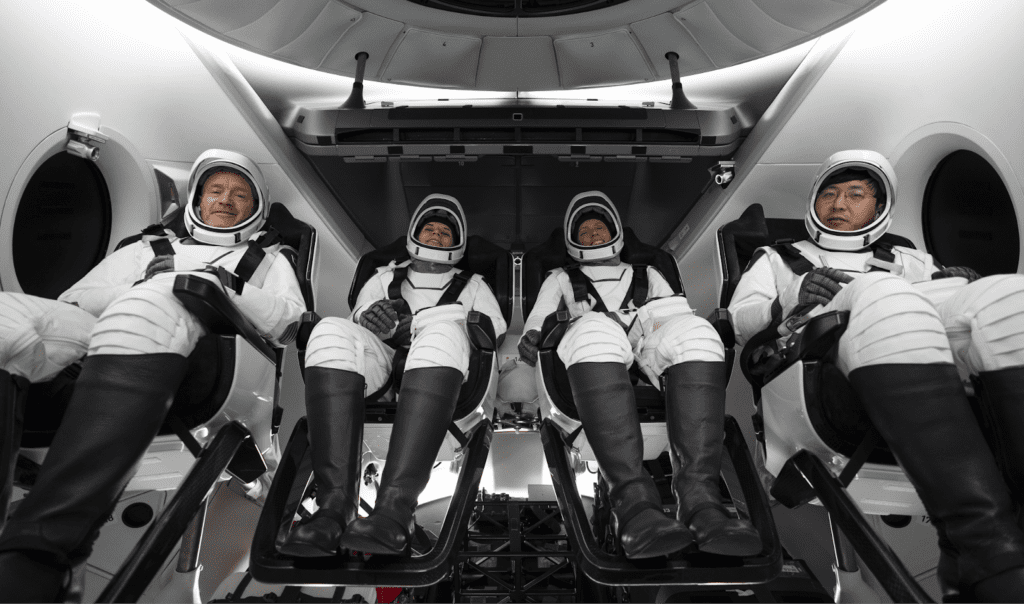
Chun Wang (far right) inside the Crew Dragon capsule with the Fram2 crew, strapped in for launch. (Credit: SpaceX via Space.com)
The next frontier was space. Wang had pitched a private polar-orbit mission to SpaceX since 2023. He funded the entire Fram2 flight himself by selling Bitcoin. No sponsors or government backing. The team trained for eight months in California simulators, doing high-G spins, zero-G flights, emergency drills, and polar survival prep.
Launch came on April 1, 2025, from Kennedy Space Center. Wang commanded from the commander’s seat. “The ride to orbit was much smoother than I had anticipated. Apart from the final minute before SECO, I barely felt any G-forces—it honestly felt like just another flight,” he posted. Zero-g was only noticed when he loosened a small stuffed polar bear by accident, and it started floating. Day one brought space motion sickness for the entire crew. “It felt different from motion sickness in a car or at sea. You could still read on your iPad without making it worse. But even a small sip of water could upset your stomach.”
By day two, the nausea passed. “I felt completely refreshed. The trace of motion sickness is all gone.” They opened the cupola over Antarctica. “Hello, Antarctica. From four hundred sixty kilometers up, it’s only pure white—no human activity visible.” The crew ran 22 experiments in three-and-a-half days: the first human X-ray in space, including hand scans with a ring, mirroring Roentgen’s 1895 original X-ray, oyster mushroom growth for Mars food code “Mission MushVroom”, female hormone tracking with urine strips, radiation monitoring, blood-flow restriction, mobile MRI, sleep tracking, and more. Radiation data showed the South Atlantic Anomaly, not the poles, delivered the highest radiation dose. The Polar orbit actually reduced time in that zone compared with ISS paths, which was noted by the highlight discovery of the trip.
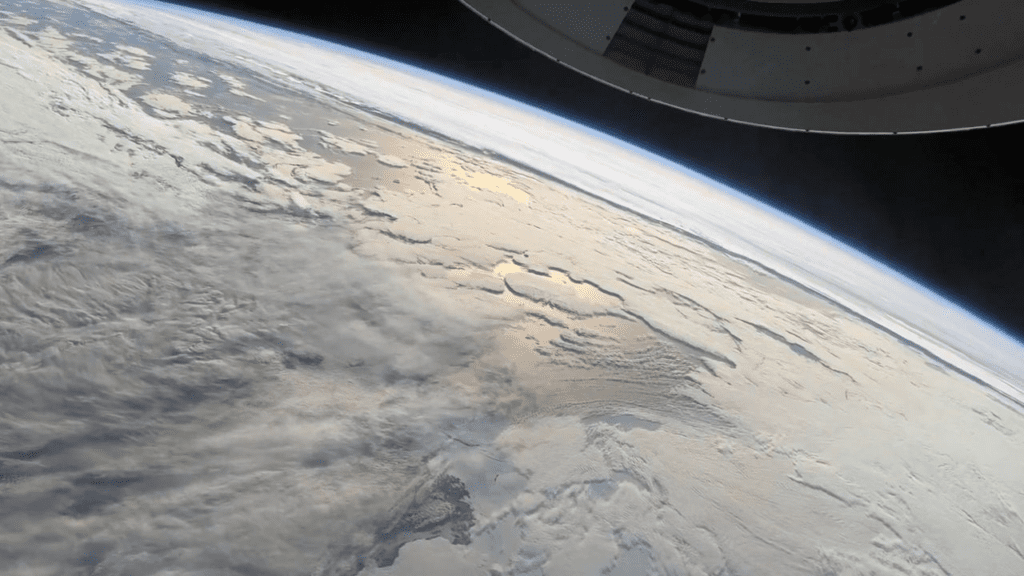
View of Antarctica from the Fram2 cupola. (Credit: Fram2 crew via Space.com)
Splashdown occurred on April 4 off California. Wang shared radiation graphs in March 2026, confirming lower-than-expected polar exposure. Full scientific papers on the experiments have not yet been published.
Since then, Wang has hardly stayed still, with his astronaut wings from SpaceX, and NASA Johnson checkups behind him, he went straight back to travel. In March 2026, he reached Bouvet Island—his 150th territory out of 249 on his travel list — via ship and helicopter, spending 201 hours on the ice before heading to Cape Town. He continues logging flights and updating his X account with photos, charts, and occasional Bitcoin and Crypto tech thoughts.
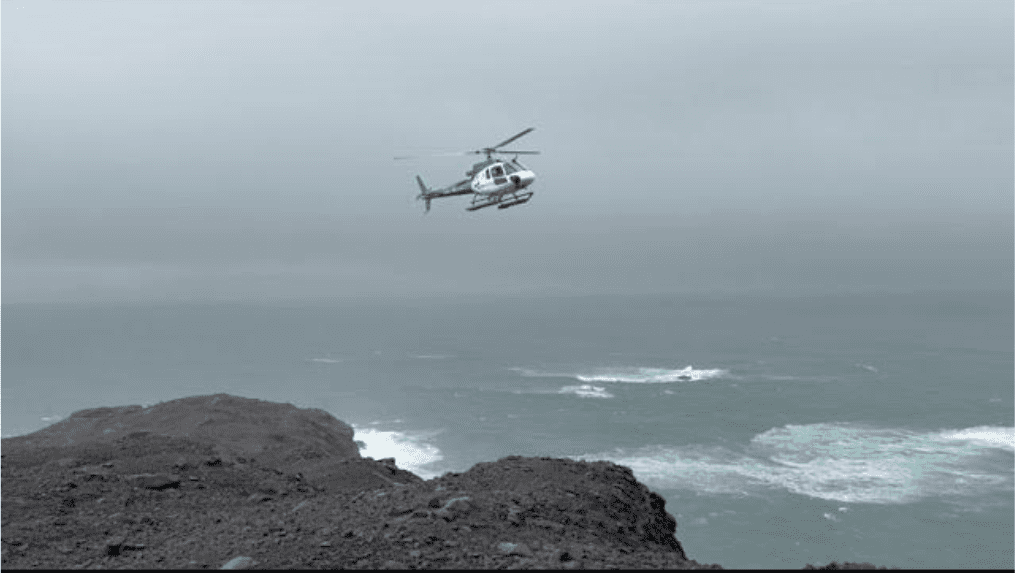
Helicopter departure from Bouvet Island, March 2026—Chun Wang’s 150th territory. (Credit: Chun Wang via X/@satofishi)