
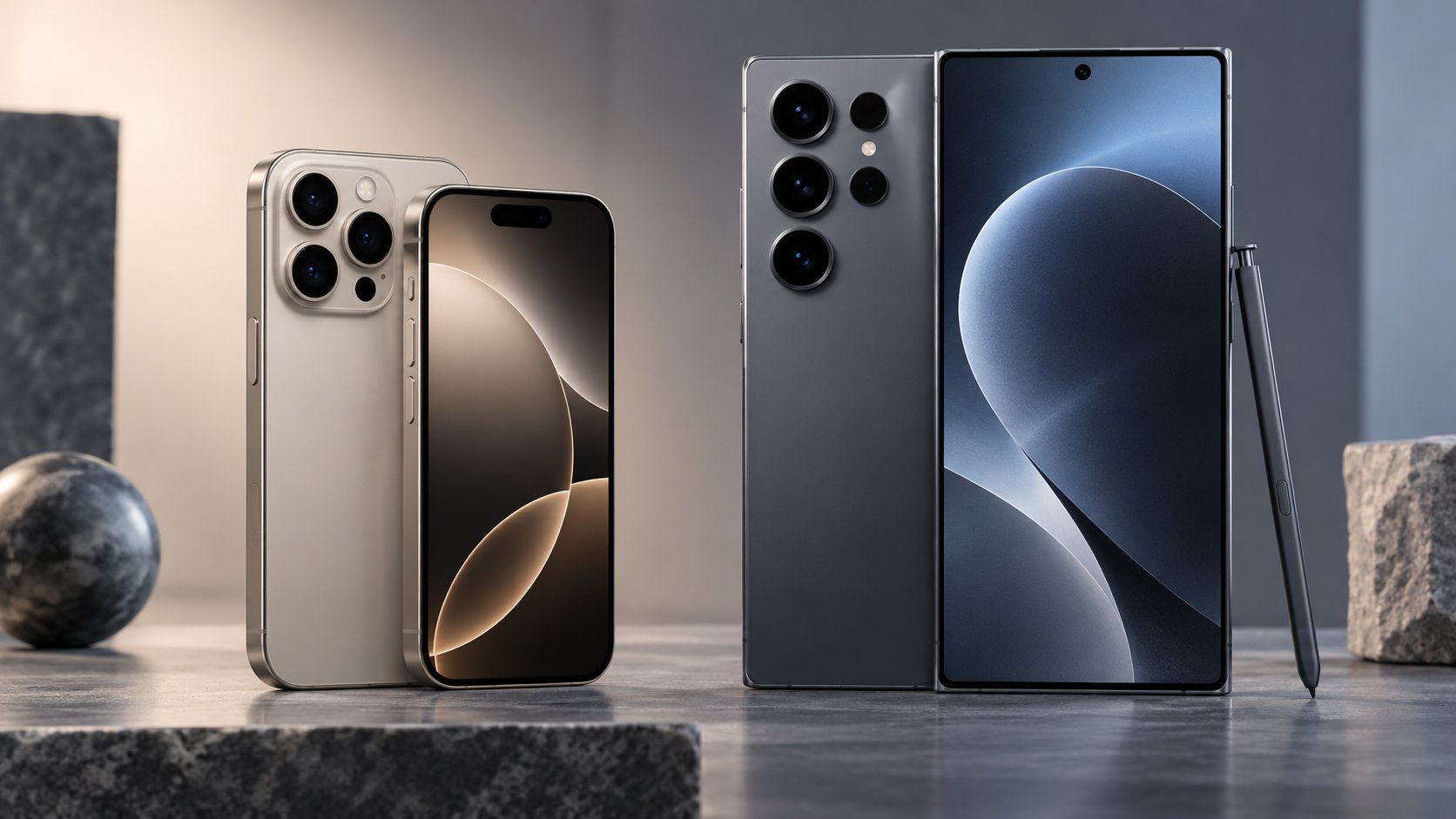
Apple and Samsung are chasing different ideas of what a premium flagship should be.
The iPhone 18 Pro puts Apple’s newest camera system and Siri AI into a relatively compact phone, while the Galaxy S26 Ultra goes big with a 6.9-inch display, built-in S Pen, long-range zoom, and Samsung DeX.
That sets up a choice between two very different flagship philosophies. Apple leans into camera control, portability, and ecosystem integration. Samsung favors screen space, productivity, and hardware flexibility.
With both firmly in four-figure territory, the better buy depends on which of those advantages you will actually use.
| iPhone 18 Pro | Galaxy S26 Ultra | |
|---|---|---|
| US list price | $1,199 | $1,299.99 |
| Display | 6.3-inch OLED, up to 120Hz | 6.9-inch AMOLED, up to 120Hz |
| Weight | 211g | 214g |
| Storage | 256GB to 2TB | 256GB to 1TB |
| Processor | A20 Pro | Snapdragon 8 Elite Gen 5 for Galaxy |
| Main camera | 48MP, variable aperture | 200MP, f/1.4 |
| Telephoto | 48MP, 4x; 8x optical-quality | 10MP 3x + 50MP 5x; 10x optical-quality |
| Battery claim | Up to 36 hours video playback on US eSIM-only model | Up to 31 hours video playback |
| Stylus | No built-in stylus | Built-in S Pen |
| Desktop mode | No dedicated desktop mode | Samsung DeX |
| Durability | IP68 | IP68 |
Pricing note: Prices shown are US list prices as of Sept. 15, 2026, and exclude temporary promotions, trade-ins, and carrier offers. Samsung is currently offering the unlocked 256GB Galaxy S26 Ultra for $1,099.99, but promotional pricing can change.
How we compared the iPhone 18 Pro vs Galaxy S26 Ultra
This evaluation uses current US pricing and official Apple and Samsung specifications. Because the iPhone 18 Pro does not reach stores until Sept. 18, manufacturer battery claims and performance figures are not treated as direct head-to-head test results.
Recommendations focus on differences buyers can act on now, including camera hardware, AI, productivity, portability, storage, and ecosystem fit.
Design and display
The phones differ sharply in size, but barely in weight.
According to Apple’s technical specifications, the iPhone 18 Pro has a 6.3-inch OLED display, weighs 211g, and measures 8.75mm thick. Samsung’s Galaxy S26 Ultra stretches to 6.9 inches while weighing only 214g and measuring 7.9mm thick.
Both displays support adaptive refresh rates up to 120Hz. Apple lists up to 3,000 nits of outdoor brightness, while Samsung rates its panel at up to 2,600 nits peak. Those vendor measurements should not be treated as identical test results, but both screens sit firmly in flagship territory.
The iPhone 18 Pro is easier to carry and use one-handed, while Samsung gives buyers considerably more screen space for video, multitasking, reading, and S Pen input.
Storage favors Apple at the top end. Both start at 256GB, but iPhone 18 Pro reaches 2TB while Galaxy S26 Ultra tops out at 1TB.
Cameras: variable aperture vs longer zoom
Apple and Samsung have taken noticeably different routes with their camera hardware.
iPhone 18 Pro uses three 48MP rear cameras. The biggest change is the main camera’s variable aperture, which can switch among f/1.48, f/1.8, f/2.8, and f/4.0 to adjust light capture and depth of field. Its telephoto provides 4x optical zoom and up to 8x optical-quality zoom.
Samsung’s official specifications pair a 200MP main camera with a 50MP ultrawide, 10MP 3x telephoto, and 50MP 5x telephoto. Samsung also lists 10x optical-quality zoom and digital zoom up to 100x.
That makes Samsung the more flexible choice for buyers who regularly shoot distant subjects. Apple instead emphasizes variable aperture, computational photography, and pro photo and video controls.
Specs alone cannot settle image quality. Comparable real-world testing will determine how the two camera systems perform. The hardware does make the intended tradeoff clear: Samsung offers more reach, while Apple gives photographers more control over its main camera.
AI and productivity
Samsung has the more established productivity toolkit today.
Galaxy S26 Ultra combines Galaxy AI features such as Photo Assist, Now Brief, and Now Nudge with a built-in Privacy Display that can limit side-angle visibility for the full screen, selected apps, notifications, or password entry. Its S Pen is stored inside the phone and requires no pairing or charging.
Samsung also supports Samsung DeX, allowing the phone to run a desktop-style interface on an external display. That gives the Ultra an advantage for buyers who want their phone to double as a larger-screen work device.
Apple’s answer is deeper integration across iPhone, Mac, Apple Watch, AirPods, and iCloud. Apple Intelligence combines on-device processing with Private Cloud Compute, while Siri AI is available in beta with iOS 27 for supported devices set to English.
Samsung’s AI features have had more time in buyers’ hands, while Apple’s newest Siri experience is only beginning its rollout. Buyers heavily invested in Apple’s ecosystem may still get more day-to-day value from cross-device integration than from any single AI feature.
Performance, battery, and charging
iPhone 18 Pro runs Apple’s new A20 Pro, while Galaxy S26 Ultra uses the Snapdragon 8 Elite Gen 5 for Galaxy. Both companies make substantial performance and AI claims, but comparable testing is still limited, so neither has a clear performance lead yet.
Battery specifications require similar caution. Apple rates the US eSIM-only iPhone 18 Pro for up to 36 hours of video playback. Samsung lists up to 31 hours for the Galaxy S26 Ultra and uses a 5,000mAh battery.
Those figures come from different testing methods, so 36 versus 31 hours isn’t a clear battery win for Apple.
Charging is also difficult to compare from percentages alone. Apple says a sufficiently powerful 60W-capable adapter can charge the iPhone 18 Pro to 50% in around 15 minutes. Samsung supports up to 60W wired charging and claims roughly 75% in around 30 minutes.
Both phones carry IP68 ratings for dust and water resistance.
Which should you buy: iPhone 18 Pro or Galaxy S26 Ultra?
Choose iPhone 18 Pro if: You want a smaller premium phone, already use several Apple devices, prefer Apple’s photo and video workflow, want the new variable-aperture camera, or need more than 1TB of local storage.
Choose Galaxy S26 Ultra if: You want a large display, longer-range zoom, a built-in stylus, Samsung DeX, Privacy Display, or a broader set of established Galaxy AI features.
| Best choice | Why | |
|---|---|---|
| Portability | iPhone 18 Pro | It delivers flagship hardware in a much smaller 6.3-inch body, although Samsung has kept its 6.9-inch Ultra impressively close in weight. |
| Productivity | Galaxy S26 Ultra | The built-in S Pen, larger display, and DeX give Samsung capabilities the iPhone does not directly match. |
| Camera flexibility | Galaxy S26 Ultra for zoom; iPhone 18 Pro for camera control | Samsung offers greater zoom range, while Apple’s variable-aperture main camera gives photographers more control. Real-world image quality will need comparable testing after Apple’s phone ships. |
| Storage | iPhone 18 Pro | Its 2TB ceiling doubles Samsung’s 1TB maximum. |
| Value right now | Galaxy S26 Ultra | Samsung is the better deal while its $200 instant discount remains available. At regular list prices, the calculation flips, with iPhone 18 Pro starting about $100 lower. |
Honestly, there’s no single winner.
Samsung offers the more versatile hardware package, particularly for zoom, stylus input, desktop use, and screen size. The iPhone 18 Pro is the better fit for buyers who want Apple’s newest flagship features in a smaller phone and already use the company’s ecosystem.
In the end, the better choice is the one that fits how you actually use your phone.
Also read: The iPhone 18 Pro vs Pixel 11 Pro comparison looks at how Apple’s new flagship stacks up against Google’s latest Pro phone.