
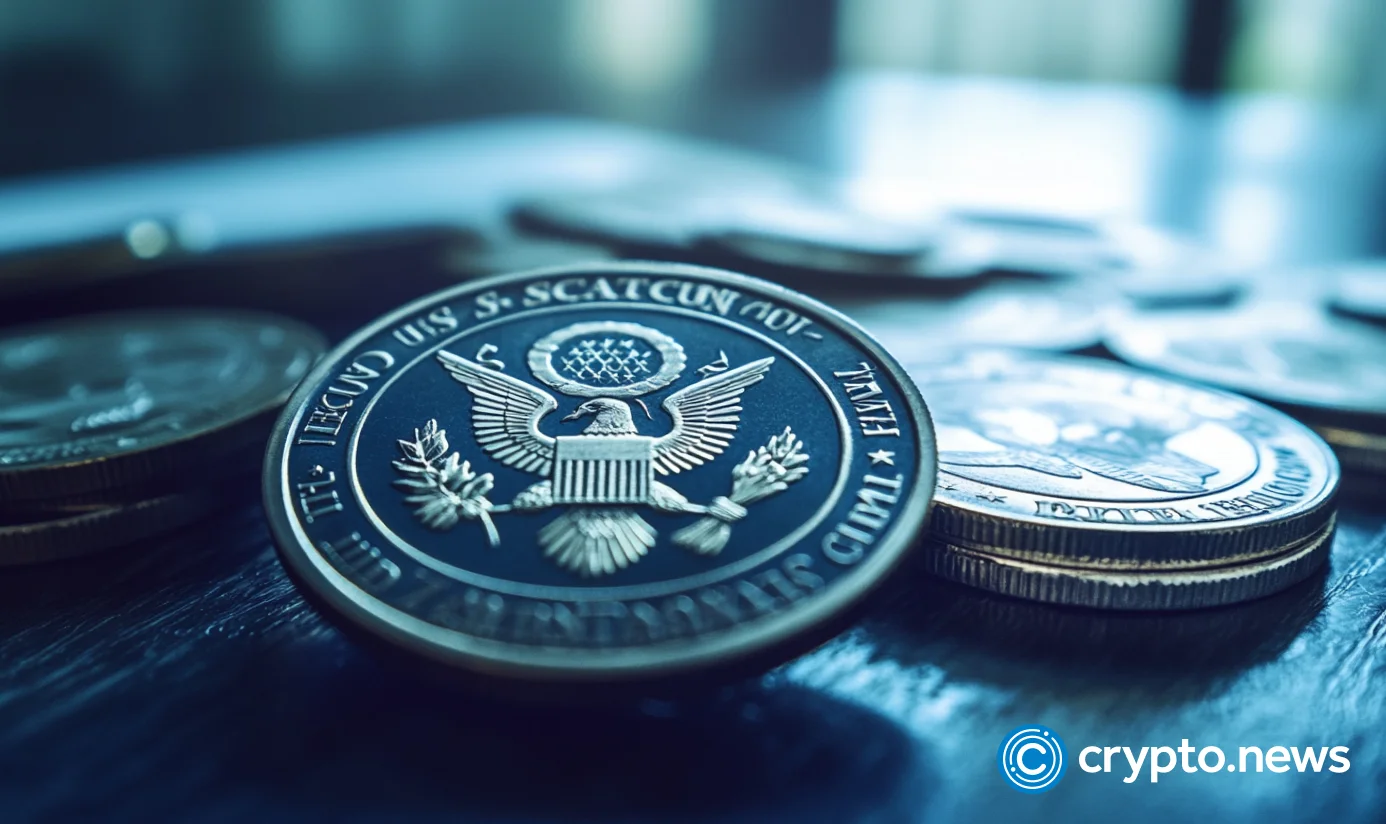
The SEC has opened a five-year route for qualifying tokenized U.S. stocks to trade through permissioned automated market makers, prompting Goldman Sachs and Citizens analysts to identify Coinbase, Robinhood and Circle as companies that could benefit if regulated onchain equity trading expands.
Summary
- SEC relief lets tokenized U.S. stocks trade through permissioned automated market makers for five years.
- Coinbase offers one-to-one-backed stock tokens on Base, but its U.S. products still need compliance changes.
- Robinhood’s overseas stock tokens provide economic exposure without full underlying shareholder rights required by SEC.
- Circle could gain USDC settlement demand because SEC permits payment stablecoins within qualifying stock-token pairs.
- Tier One tokenized stocks face seventy-five-symbol limits and 0.25% volume caps under the exemption framework.
The Securities and Exchange Commission said on Sept. 17 that its Innovation Exemption grants temporary conditional relief to Tokenized Securities Venues, or TSVs, that use AMM liquidity pools for secondary trading of tokenized National Market System stocks. The framework excludes synthetic stock products and requires eligible tokens to convey the same rights as the equivalent traditional shares.
Under the order, qualifying tokenized stocks must give holders the same company interest, dividends, voting rights and liquidation rights as conventional shares of the same class. Primary offerings cannot use the exemption, while securities offered and sold under the framework must still satisfy Securities Act registration requirements or qualify for another exemption.
Third-party tokenizers face an issuer notice requirement. A TSV must inform the underlying public company before listing an unaffiliated third party’s tokenized version of its shares, then wait at least 30 calendar days. If the issuer objects within that period, the venue cannot begin trading the token.
The SEC placed limits on both the number of stocks and their trading volume. Tier 1 securities, covering stocks in the S&P 500, Russell 1000 and certain highly traded exchange-traded products, are limited to 75 symbols on a TSV and 0.25% of each stock’s prior-month average daily share volume. Tier 2 is capped at 250 symbols and 2.5% of prior-month average daily volume.
A repeat breach of a stock’s volume ceiling requires the venue and affiliated TSVs to stop trading that tokenized stock for three months. The SEC said the caps are designed to limit possible price dislocations between AMM-traded tokens and shares trading through conventional markets.
The framework requires smart contracts used by qualifying venues to be auditable and public while running on public, permissionless distributed ledgers. Access to the actual TSV must remain permissioned. Venues must stop token trading whenever the underlying stock is halted on its primary listing exchange.
Ascrypto.news reported on the five-year SEC exemption, synthetic products offering only price exposure do not qualify. A subsequent review of the shareholder-rights requirement noted that the SEC’s framework separates tokens carrying actual shareholder rights from products structured as derivatives or debt claims.
Coinbase already has several pieces of the required model
Goldman Sachs analysts identified Coinbase as a potential beneficiary because the company already operates tokenization, custody, stablecoin and blockchain infrastructure that could support onchain equity markets. Coinbase’s international tokenized stocks are backed one-for-one by real shares held in regulated, bankruptcy-remote custody.
Coinbase says holders have a senior beneficial claim on the underlying equity, while dividends and stock splits are incorporated through an onchain multiplier. Primary creation and redemption are restricted to KYC-approved institutional partners and authorized participants. Its current products are offered under Regulation S and are unavailable to U.S. persons.
Voting remains one item still being developed. Coinbase President Emilie Choi said during the Goldman Sachs Communacopia conference that the products already carry dividend rights and that voting options are being added. She described implementing those rights as a technology task instead of a change in the fundamental security structure.
Coinbase’s Base stock tokens, the company began with Apple, Nvidia, Meta and Alphabet products before expanding its lineup. The tokens use Coinbase’s B20 standard and can move into supported DeFi applications on Base.
Activity has moved beyond simple spot trading. Token Terminal data cited by crypto.news in its Base tokenized-stock market report showed $730.9 million in DEX volume during the 30 days through Sept. 12, with Aerodrome accounting for $557.1 million.
Morpho then opened lending markets for five Coinbase-issued stock tokens. By Sept. 18, users had posted $104,401 of stock tokens as collateral and borrowed $54,652 in USDC, according to crypto.news coverage of the Morpho integration.
Goldman’s analysis identifies a separate issue if Coinbase wants to operate a U.S. TSV itself. Coinbase’s conventional exchanges use central limit order books, while the new SEC relief specifically covers AMM liquidity pools. Goldman said Coinbase could develop AMM infrastructure or route activity through qualifying decentralized venues, including protocols operating on Base.
Robinhood’s current tokens do not meet the SEC test
Robinhood enters the U.S. discussion with an established overseas stock-token business, but its existing legal structure differs from the securities covered by the exemption.
Robinhood’s second-quarter SEC filing states that its Stock Tokens are tokenized debt securities issued by Robinhood Assets (Jersey) Limited. They provide economic exposure to referenced securities but do not grant holders legal or beneficial rights in the companies whose shares underpin the products.
That distinction conflicts with the Innovation Exemption’s requirement that token holders receive the same interest, dividends, voting rights and liquidation rights as traditional shareholders. Goldman analysts therefore said Robinhood would need further product development before offering a U.S. product under this particular framework.
Robinhood has already indicated that its design is evolving. CEO Vlad Tenev said in September that the company intends to introduce share redemption and voting features, while its newer onchain stock products can move outside the Robinhood app and interact with DeFi smart contracts.
The company’s earlier offshore model became part of a public dispute with AMC Entertainment after Robinhood introduced an AMC-linked token without the company’s approval. Robinhood-AMC dispute, holders received economic exposure but not direct shareholder rights.
Tenev later argued that issuer approval should depend on what legal rights a token creates, not simply whether blockchain technology is involved. The SEC’s final exemption takes a different procedural approach for unaffiliated third-party tokenization by granting the underlying issuer a 30-day window to prevent its shares from trading on a TSV.
Robinhood Chain gives the company existing onchain infrastructure to build around. Robinhood launched the chain’s mainnet in July and opened stock tokens to smart-contract use, including DeFi pools and third-party applications.
Circle exposure comes through settlement and collateral
Circle’s connection to the SEC order is indirect because the company does not need to issue tokenized stocks to participate in the market analysts describe.
The SEC order permits a tokenized NMS stock to trade in a pair with another tokenized stock, a tokenized money market fund or a non-security crypto asset, including a qualifying payment stablecoin. That creates a regulatory route for stablecoins to serve as the other side of qualifying AMM pools.
Goldman Sachs and Citizens analysts identified USDC as a possible settlement and collateral asset if tokenized-equity activity grows. Circle already markets USDC as settlement infrastructure for tokenized assets. On Cronos, for example, Circle says USDC serves as the dollar settlement layer for an application designed to support tokenized stocks, crypto and prediction markets.
Circle’s institutional work extends into tokenization infrastructure through Arc. Its second-quarter update said BlackRock, BNY, DTCC and Standard Chartered were developing or examining integrations involving tokenized-asset settlement, custody, stablecoin access, foreign exchange and repo markets. DTCC plans to enable tokenization of DTC-custodied assets on Arc.
Existing Base activity supplies an early example of stock tokens interacting with USDC. Morpho’s Coinbase tokenized-stock markets use USDC for borrowing, although their current scale remains small beside conventional U.S. securities markets.
Trading caps limit the initial challenge to traditional exchanges
Goldman does not expect the exemption’s first phase to pull substantial trading volume away from Nasdaq or Intercontinental Exchange, the owner of the NYSE. The bank cited the SEC’s volume caps, symbol limits, issuer objections and AMM market structure as constraints on the experiment.
The SEC itself acknowledges AMM pricing can diverge from conventional equity markets because pool prices generally depend on the ratio of assets deposited into a liquidity pool. Its volume limits were designed partly to contain potential price dislocations while regulators collect operating data.
Traditional market infrastructure is pursuing a separate tokenization path. DTCC said in May that DTC’s tokenization service would begin with limited production transactions in July before a planned October 2026 launch, following work with more than 50 financial companies. Participants include Circle, Coinbase, Goldman Sachs, BlackRock, Bank of America and several major trading and custody firms.
The TSV route has its own waiting period before a qualifying venue can operate. The SEC requires a prospective TSV to publish a detailed public notice at least 30 calendar days before starting operations and notify the Commission within one business day of publishing it.
Public feedback remains open. The SEC’s comment page currently lists no closing date for comments on File No. 4-927, while Chairman Paul Atkins has described the exemption as a temporary bridge that is expected to inform later rulemaking.
FAQs
Does the SEC exemption allow synthetic stock tokens?
No. The order excludes crypto assets that represent a third party’s own security while providing synthetic exposure to another stock, including tokenized linked securities and tokenized security-based swaps.
Can Coinbase immediately offer its existing stock tokens to U.S. investors?
No. Coinbase’s current products operate under an offshore Regulation S structure and remain unavailable to U.S. persons. A U.S. offering would need to comply with the conditions applicable to the security and trading venue.
Why would Robinhood need to change its current stock tokens?
Its existing Stock Tokens provide economic exposure through debt securities without granting legal or beneficial rights in the referenced companies. The SEC exemption requires equivalent shareholder rights for qualifying tokenized NMS stocks.
Does the SEC framework specifically require USDC?
No. The order permits qualifying tokenized stocks to pair with non-security crypto assets, including permitted payment stablecoins. It does not require a specific stablecoin. Analysts identified USDC as one possible beneficiary.