


Cardano price has climbed to around $0.279 on Oct. 6 as ADA approaches the $0.28 resistance area, while derivatives positioning and whale activity point to new leveraged bets entering the market.
Summary
- ADA trades near $0.279 after gaining almost 9% weekly, while leverage and whale activity rise.
- Santiment says open interest climbed 25% during the rally, weakening claims of a short squeeze.
- Weekly RSI at 56.47 shows stronger momentum without placing Cardano in traditional overbought territory yet.
- RealFi launched on Cardano mainnet October 1, bringing RWA-backed USDrf and sUSDrf to the network.
- Cardano attends TOKEN2049 Singapore on October 7 and 8 after its Summit funding proposal failed.
CoinGecko data showed ADA up roughly 2.7% over 24 hours and close to 9% over seven days, with a market value above $10 billion. CoinGlass separately placed ADA near $0.279 with futures open interest around $696 million at the latest reading.
The move extends a recovery that took ADA from around $0.244 on Oct. 3 to above $0.27 by Oct. 5. CoinGecko historical data records an Oct. 3 close near $0.244 and an Oct. 5 close around $0.270.
Cardano price is testing resistance around $0.28
ADA has pushed through a long-running descending trendline on the weekly chart and is now testing the 0.277–0.28 area, which previously acted as an important price zone.
The weekly Bollinger Bands place the upper band near $0.2738, with ADA trading slightly above it. The middle band sits around $0.1997 and the lower band near $0.1255. Trading above the upper band shows strong momentum, though it leaves the price stretched relative to its recent weekly range.
RSI stands near 56.47, above both the neutral 50 level and its moving average around 44.07. The indicator remains comfortably below the traditional 70 overbought threshold.
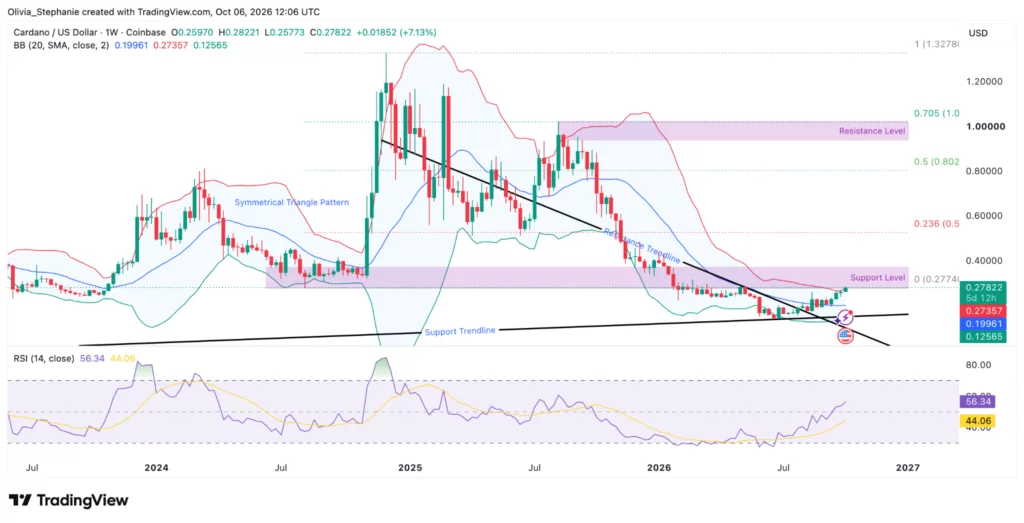
A weekly close above roughly $0.277 would strengthen the current breakout structure. The next immediate area is around $0.30, followed by the 0.35–0.40 range shown on the weekly chart. Fibonacci resistance appears close to $0.50, while $0.80 and the 0.95–1 region sit much farther above.
Those higher levels remain technical reference points, not confirmed targets. The current weekly candle has not closed, leaving open the possibility that ADA falls back below the breakout area.
In crypto.news coverage of ADA’s Oct. 5 breakout, the token had already reached $0.2768 before easing, with 0.28–0.29 identified as the next historical price zone. The same analysis placed $0.2887 as a higher-timeframe confirmation level cited by one trader.
Rising open interest challenges the short-squeeze explanation
Santiment has pushed back against claims that ADA’s latest rally was mainly caused by short sellers being forced to close positions.
The analytics firm said its daily-close data showed ADA rising roughly 10% between Oct. 3 and Oct. 5 while open interest increased approximately 25% to $304 million.
Measured in ADA instead of dollars, Santiment said open interest still increased around 13%. That distinction reduces the chance that the increase came solely from ADA becoming more valuable while the number of open contracts remained unchanged.
Short covering likely played some role. Funding had reached its most negative reading in a month on Oct. 2 before later turning positive, according to Santiment. Closing short positions normally reduces open interest, however, while the firm’s series showed outstanding positions increasing during the rally.
Different derivatives providers report different headline open-interest totals because they track different exchanges and instruments. CoinGlass currently shows aggregate ADA futures open interest near $696 million across its covered venues, with 24-hour futures volume around $1.17 billion.
Whale activity rose at the same time. Santiment counted 413 ADA transactions worth at least $100,000 on Oct. 5, roughly 2.2 times the weekday average recorded between Sept. 7 and Oct. 2.
Social volume was much less extreme, reaching around 1.1 times its earlier baseline. The gap between whale transactions and social discussion suggests the increase in large transfers was much stronger than the increase in Cardano-related chatter, based on Santiment’s measurements.
RealFi went live before ADA accelerated
Cardano gained a fresh ecosystem development immediately before the latest price advance, though the timing needs a correction from some market reports.
RealFi officially launched on the Cardano mainnet on Oct. 1, the project confirmed in its official blog, while Intersect recorded the same launch date in its Oct. 2 ecosystem update.
The protocol introduced USDrf and sUSDrf. RealFi describes USDrf as a dollar-linked asset backed by a portfolio that includes direct lending, money-market instruments, U.S. Treasury bills and floating-rate bonds. Users can stake USDrf for sUSDrf, which carries exposure to the protocol’s yield structure.
RealFi’s launch partners included SundaeSwap, Lace and Liqwid. Intersect said the service opened its Voyager Season as it moved from testing into live Cardano activity. Access is restricted in some regions, including the U.S., U.K. and European Union.
Network data has improved during ADA’s price recovery, although not every Cardano metric is moving higher. DefiLlama shows Cardano DeFi TVL near $70 million at the latest reading, while seven-day decentralized-exchange volume stood above $42 million and had risen sharply from the previous week. Stablecoin market capitalization remained around $67 million.
The current TVL remains well below levels recorded in earlier Cardano cycles, so the recent increase does not by itself show that network activity has returned to previous highs.
$0.30 comes first before larger Cardano targets
Analyst Lucky Luciano has taken a more bullish view of the price structure after ADA moved beyond its long-running downtrend.
Luciano said on Oct. 5 that, in his view, ADA was “setting its tone for another parabolic run.” His chart showed ADA escaping a descending trendline that had capped price since September 2025.
His projection pointed toward a move roughly 60% above ADA’s price when the analysis was posted. It remains an analyst scenario and is not confirmed by current price action.
For the immediate setup, $0.30 sits much closer. ADA needs to remain above roughly $0.277 and clear the 0.28–0.29 area before that level comes into play. Losing the breakout would bring the upper Bollinger Band around $0.274 back into focus, followed by lower support zones.
Cardano has another scheduled event on Oct. 7 and 8. The project’s official TOKEN2049 page states that Cardano will have its largest Asia-Pacific presence yet at the Singapore conference, with Cardano Foundation CEO Frederik Gregaard and ecosystem developers appearing at its booth.
The appearance follows the cancellation of a separately proposed Cardano Summit after the community rejected the required treasury funding. As previously reported in crypto.news coverage of the rejected 7.8 million ADA Summit proposal, the vote received 65.2% support but failed to reach the required two-thirds threshold.
TOKEN2049 itself begins Oct. 7 at Marina Bay Sands and runs through Oct. 8, with organizers listing more than 25,000 expected attendees, 300 speakers and 500 exhibitors.
Separately, Cardano founder Charles Hoskinson renewed his long-running request for Gemini to list ADA after Gemini co-founder Tyler Winklevoss posted about the exchange’s anniversary. Hoskinson’s Oct. 6 response simply said “List ADA.”
Gemini’s official supported-assets disclosures do not currently show ADA among its main trading assets, while its listing framework says projects undergo technical, legal, compliance, cybersecurity and market-integrity reviews before approval. Gemini has not announced an ADA listing in response to Hoskinson’s latest request.
Disclosure: This article does not represent investment advice. The content and materials featured on this page are for educational purposes only.