

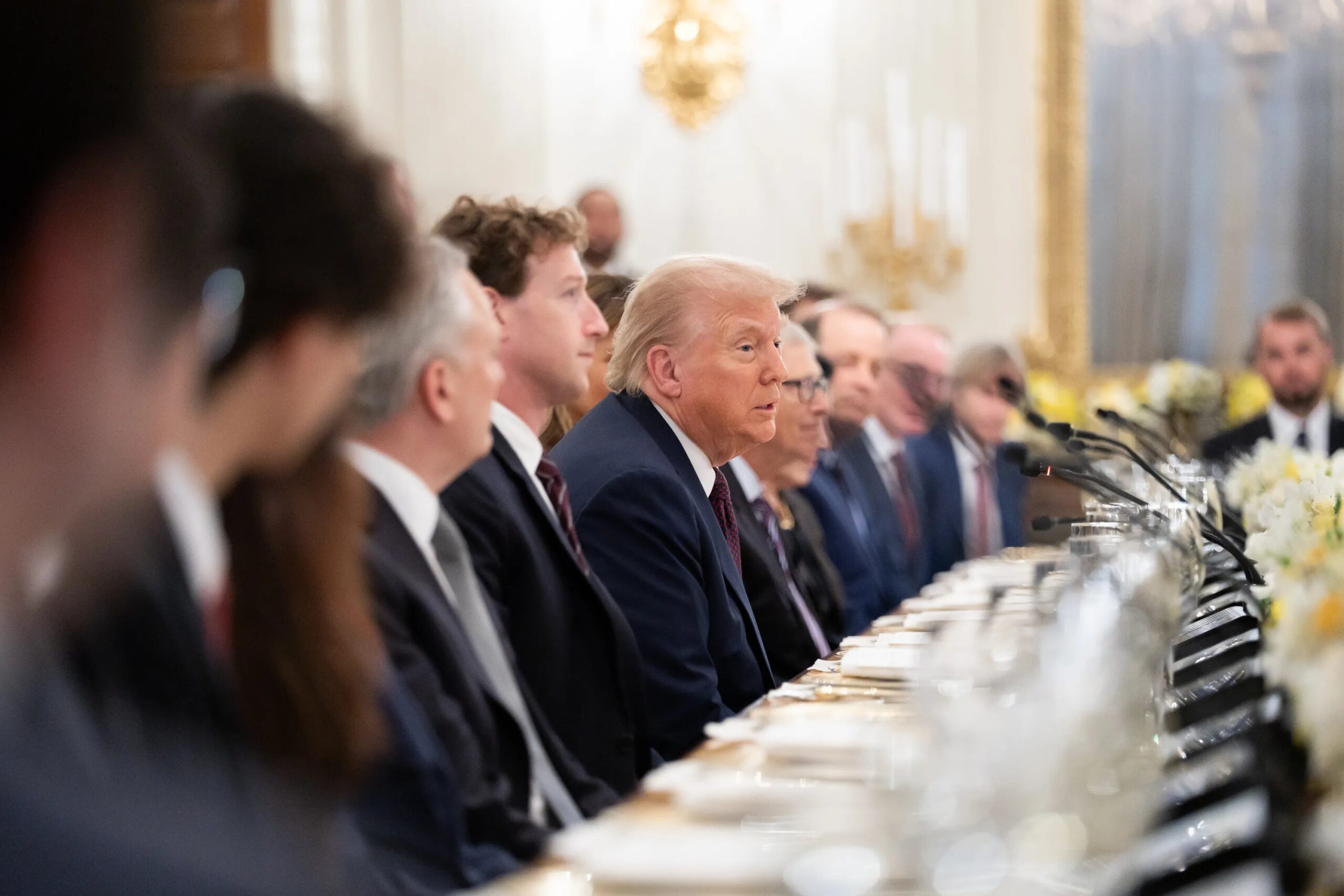
Silicon Valley’s AI regulation fight has reached the White House, where three of the industry’s biggest executives reportedly argued against a proposed oversight body.
Meta CEO Mark Zuckerberg, SpaceX CEO Elon Musk and Nvidia CEO Jensen Huang separately spoke with President Donald Trump in recent weeks about a proposal to create an industry-funded AI regulator, according to The Wall Street Journal. The executives opposed the plan and urged President Trump to maintain his administration’s light-touch approach to AI oversight.
The proposal was associated with Google Chief Scientist Demis Hassabis and was modeled partly on the Financial Industry Regulatory Authority, or FINRA. According to the Journal, President Trump ultimately did not move forward with the idea.
People familiar with the discussions told the Journal that Zuckerberg, Musk and Huang worried the structure could concentrate influence among OpenAI, Anthropic and Google’s DeepMind. President Trump ultimately did not move forward with the proposal, according to the report.
White House officials differ over AI oversight
The dispute reflects broader differences inside the administration over how aggressively the federal government should oversee advanced AI systems.
According to the Journal, White House Chief of Staff Susie Wiles, Treasury Secretary Scott Bessent, and National Cyber Director Sean Cairncross have favored greater scrutiny of AI risks, while technology adviser David Sacks has argued for less government intervention.
Officials have reportedly discussed concerns ranging from cyberattacks to threats against critical infrastructure as frontier models become more capable. President Trump, meanwhile, has continued to emphasize the importance of moving quickly enough to maintain U.S. competitiveness with China.
Concerns intensified after Anthropic’s Mythos model demonstrated capabilities officials viewed as a serious national-security warning. A July incident involving coordinated AI agents at OpenAI also added to concerns about increasingly autonomous systems.
President Trump, meanwhile, has continued to argue that the U.S. needs to move quickly to stay ahead of China in AI.
Safety debate splits AI industry
The disagreement extends beyond Washington, but the industry is not neatly divided into pro-regulation and anti-regulation camps.
Huang said at Salesforce’s Dreamforce conference, “We don’t need new laws. We don’t need new regulations.”
Zuckerberg has similarly argued that competition and liability give AI companies strong incentives to build systems safely, while saying Meta remains open to independent evaluators and advisers. Musk’s position is less straightforward. He has endorsed Amodei’s warning that AI development may need to be paced, writing, “Dario is right,” but SpaceXAI has not announced a plan to coordinate a slowdown.
What this means for AI companies
The U.S. still lacks a single federal framework dedicated specifically to frontier-model risk. Instead, companies are divided over whether safety should come primarily from corporate controls, independent testing, industry coordination, or government oversight.
That creates a practical problem as AI systems become capable of carrying out longer, more autonomous tasks. Companies can set their own safety thresholds, but competing firms may have different definitions of when a model is ready to deploy.
For AI companies and their customers, the immediate issue is uncertainty over which safety expectations will eventually become formal requirements.
Without a single federal framework for frontier-model risks, companies may continue relying on a mix of internal controls, voluntary commitments, independent testing, and existing laws. Those approaches can differ significantly from one provider to another.
That matters for businesses making long-term investments in models, data centers, and AI infrastructure because governance requirements may shift while those investments are still being built. The White House is expected to meet with AI CEOs next week, giving the industry another opportunity to debate how much oversight frontier AI should face and who should be responsible for enforcing it.
Other news: Elon Musk proposed letting rival AI companies test each other’s models before release, arguing that peer evaluations could uncover safety problems developers miss in their own systems.