

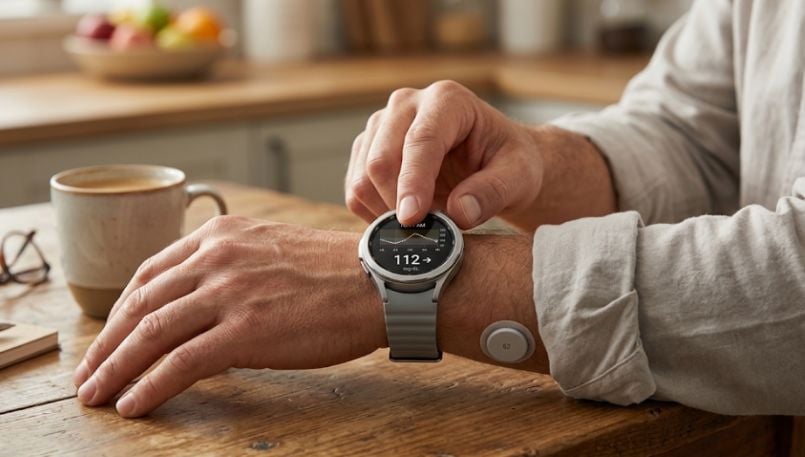
A newly published Samsung patent offers another look at how the company is exploring wearable glucose measurement, just as Samsung separately confirmed that noninvasive continuous glucose monitoring remains an active research priority.
A Samsung European patent application published Sept. 9 describes a wearable system that combines biometric signals with a glucose reading from an external device to create calibration data. That calibration could then help the wearable determine a user’s glucose values from biometric signals.
Separately on Sept. 9, Samsung publicly confirmed that it is still pursuing noninvasive continuous glucose monitoring. Together, the developments offer a fresh look at Samsung’s work on glucose technology, although the company has not announced a Galaxy Watch capable of independently measuring blood glucose.
Samsung patent uses an external glucose reading for calibration
The Samsung patent, published as EP4803002A1, describes a wearable electronic device equipped with sensors, memory, a display, communications hardware, and a processor.
Its glucose-measurement process starts with something important: a blood glucose reading taken by an external device.
According to the filing, the wearable can identify a time for the user to measure their glucose using that external device. Around the same time, a sensor on the wearable collects a biometric signal from the user.
The wearable can then obtain the externally measured glucose value and combine it with the biometric signal to generate calibration data. That calibration data can subsequently be used to determine glucose values from biometric signals measured by the wearable.
In other words, the patent describes a system that could use a known glucose measurement to calibrate biometric data collected by a wearable rather than expecting the device to produce an accurate glucose reading from scratch.
The Sept. 9 European publication is new, but the patent family traces its priority to Dec. 11, 2023. A Korean application was published June 18, 2025, followed by an international PCT publication on June 19, 2025.
The filing also refers broadly to a “wearable electronic device.” It does not name a specific Galaxy Watch model or confirm that the technology will be incorporated into a commercial Samsung product.
Samsung says noninvasive glucose research is still underway
Samsung’s separate comments on Sept. 9 provide timely context for the patent publication.
During a health briefing that day, Jong-min Choi, an executive vice president on Samsung Electronics’ Digital Health Team, said Samsung continues to pursue noninvasive continuous glucose monitoring through several approaches.
“We are pursuing a multifaceted approach that includes global technology exploration, in-house research, and collaboration with external startups (POC),” Choi said, according to EDaily. Choi also acknowledged the technology’s challenges, saying Samsung continues to focus on improving its reliability.
Samsung is looking beyond the watch alone. Choi said wearing a Galaxy Ring and Galaxy Watch together can significantly improve sensor measurement accuracy. Samsung’s broader vision involves connecting watches, rings, smartphones, and Galaxy Buds to create a more personalized AI healthcare ecosystem.
Electronic Times separately reported that Samsung continues to research noninvasive glucose monitoring as it expands the Galaxy Watch into a broader digital-health platform.
The comments confirm that noninvasive continuous glucose monitoring remains an active Samsung research effort, not merely technology described in earlier patent filings.
The patent does not mean a glucose-reading Galaxy Watch is coming
There is still a substantial gap between Samsung’s research and a Galaxy Watch capable of independently measuring blood glucose.
Samsung has not announced such a Galaxy Watch, provided a launch date for the technology, or said that the method described in EP4803002A1 will be incorporated into a future product.
TechRepublic has previously examined Samsung’s broader blood sugar research, including what current Galaxy Watches can and cannot do. The Sept. 9 patent publication adds a new development to that longer-running effort rather than changing the capabilities of watches already on users’ wrists.
That distinction is especially important with glucose technology.
The U.S. Food and Drug Administration has warned consumers against smartwatches and smart rings that claim to independently measure or estimate blood glucose without piercing the skin. The agency has said it has not authorized, cleared, or approved a smartwatch or smart ring intended to independently perform that function.
Galaxy Watches already offer health metrics that can sometimes create confusion about what the devices actually measure. Samsung’s AGEs Index, for example, provides information on advanced glycation end products but does not provide a direct blood glucose reading. TechRepublic has previously explained what the Galaxy Watch AGEs Index actually measures.
What’s hot at TechRepublic
What Galaxy Watch owners should take from Samsung’s patent
For Galaxy Watch owners, nothing changes today.
The Sept. 9 publication does not add independent glucose measurement to an existing watch, confirm the feature for Samsung’s next wearable, or establish when the technology might become commercially available. Anyone who relies on glucose readings for medical decisions should continue using appropriately authorized glucose-monitoring technology.
What has changed is the evidence surrounding Samsung’s ongoing work. On Sept. 9, a European patent publication provided a detailed look at one approach Samsung has explored for calibrating wearable glucose measurements. Separately that day, a Samsung executive confirmed that the company remains actively interested in solving the problem of noninvasive continuous glucose monitoring.
The next meaningful signals will be more concrete: clinical validation results, regulatory filings, or an actual Samsung product announcement.
Until one of those arrives, the patent is best viewed as a window into Samsung’s research rather than a preview of the next Galaxy Watch. But for anyone waiting for a mainstream smartwatch to make the leap into independent glucose measurement, Samsung has made one thing clear: it is still working on the problem.
Read more: How accurate is Samsung Galaxy Watch body composition? See what research says about its body fat and muscle measurements.


